| Tests | Description | Values to remember |
|---|---|---|
| Interpalpebral fissure height | Vertical aperture height from the lower eyelid to the upper eyelid. Abnormal lower eyelid positions shoul be noted | Normal: 8-12 mm |
| Marginal reflex distance | Distance from the cornea light reflex and upper eyelid margin. A negative value is given if the upper lid margin obstructs the corneal reflex The value is obtained measuring the palpebral shift until the reflex appears | Normal: 4-4.5 mm Abnormal: Mild +1.5mm, Moderate +0.5mm Severe -0.5mm |
| Levator function | Distance from upper palpebral margin position in down-gaze and the upper palpebral margin position in up-gaze. Securing one's tumb over the brow the frontalis muscle contribute is negated. | Excellent: 13-15mm Good: 8-12mm Fair: 5-7mm Poor: 4mm |
| Upper lid crease position | Distance between the central lid crease to the lash margin in down-gaze | High lid crease – aponeurotic deiscence Absent lid crease – congenital ptosis |
| 2.5% phenilephrine | To stimulate Müller's muscle. 2 drops and waiting 5 minutes. | A positive response is useful to determine the posterior lamellar feasibility and/or to extimate the postoperative palpebral drop relate to Hering's law. |
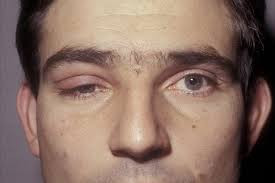
Tests for Blepharoptosis
Last updated: September 2026
Putting the measurements together: severity grading and surgical decision-making
The individual tests above (MRD1, levator function, phenylephrine test) matter clinically because together they determine both ptosis severity and which surgical approach is appropriate — not just whether ptosis is present.
| Severity (by MRD1) | Typical levator function | Preferred surgical approach |
|---|---|---|
| Mild (MRD1 2-3mm) | Good to excellent (≥8mm) | Müller's muscle-conjunctival resection (especially if phenylephrine test positive), or small levator advancement |
| Moderate (MRD1 0-2mm) | Fair to good (5-12mm) | Levator resection/advancement, tailored to the measured function |
| Severe (MRD1 <0, i.e. lid covers the pupil) | Poor (≤4mm) | Frontalis suspension (brow-to-lid sling) — levator function is too poor for a levator-based procedure to work reliably |
Why the phenylephrine test matters practically
A positive response (measurable lid elevation after topical phenylephrine stimulates Müller's muscle) suggests the posterior lamellar approach (Müller's muscle-conjunctival resection) will work well — this avoids an external incision and generally gives a very predictable outcome. A negative or minimal response points toward an anterior approach (levator advancement/resection) instead.
Don't forget Hering's law
Always examine both eyelids together, not just the ptotic one. In unilateral ptosis, the brain may be sending excess innervation to both levators to compensate — surgically correcting only the more severe eye can unmask latent ptosis in the "normal" fellow eye once the compensatory over-innervation is no longer needed. This is exactly why the phenylephrine test result is used to estimate postoperative fellow-eye lid position, not just the operated eye.
📘 Want the exam-ready deep dive? This topic, and much more is covered in Ophthalmology Explorer (A High-Yield Clinical Reference for Ophthalmology Residents, Fellows & Board Exams) — available on Kindle. See all my books.
Experiencing symptoms like these? Learn about our Eye Department or book a consultation with Dr. Dhaval Patel.