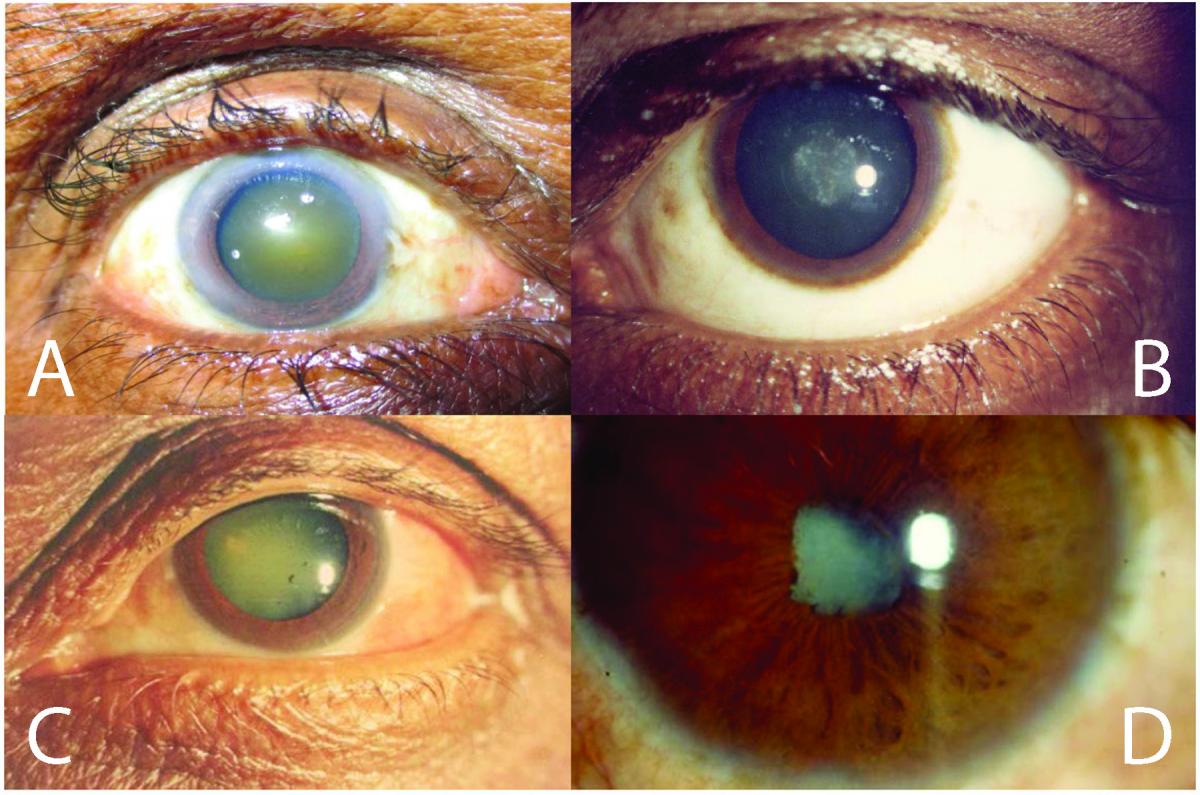
Eye Disease and Leprosy
Below Details are Adapted from the American Academy of Ophthalmology Summary Benchmarks, November 2010 (www.aao.org)
(Ratings: A: Most important, B: Moderately important, C: Relevant but not critical Strength of Evidence: I: Strong, II: Substantial but lacks some of I, III: consensus of expert opinion in absence of evidence for I & II)
Initial Exam History
- Ocular symptoms (decreased vision, epiphora, symptoms of irritation) (A:III)
- Duration of lagophthalmos (
6 months) (A:III) - Duration of leprosy (usually from date of diagnosis) (B:III)
- Type of leprosy (A:III)
- MDT treatment; what drugs and for how long (A:III)
- History of leprosy reactions (B:III)
Initial Physical Exam
- Visual acuity (A:III)
- Eyelids and lid closure (A:III)
- Corneal sensation (A:III)
- Conjunctiva (A:III)
- Sclera (A:III)
- Pupil (A:III)
- Nasolacrimal apparatus (A:III)
- Slit lamp biomicroscopy
- Corneal epithelial integrity (A:III)
- Corneal nerve beading, stromal opacity (B:III)
- Anterior chamber (A:III)
- Iris atrophy (A:III)
- Iris "pearls" (B:III)
- Posterior synechiae (A:III)
- Cataract (A:III)
Care Management
The main important conditions (cataract, lagophthalmos, anterior uveitis) are managed as for any patient, and people with leprosy should be integrated into the normal eye care service, specifically:
- Cataract should be removed when it adversely affects patient's visual function (A:III)
- IOL is not contraindicated as long as quality of surgery is good and eye is quiet (A:III)
- Chronic lagophthalmos should be treated surgically if cornea is compromised or cosmesis is a problem, regardless of severity of lagophthalmos, by whatever procedure the surgeon does best (A:III)
- Special considerations in a person afflicted with leprosy include:
- New onset lagophthalmos (duration <6 months) should be treated with oral prednisolone 25-30 mg per day tapered over 6 months. (A:III)
- Acute uveitis should be treated with intensive topical steroid; associated systemic leprosy reaction must be ruled out or treated if present with systemic steroid give dose) (A:III)
Patient Education
- At the end of MDT all patients should be warned that lagophthalmos could develop and understand the risks associated with this. (A:III)
- Patients with residual lagophthalmos must be told about the risk form exposure and specifically warned about development of red eye and decreased vision. (A:III)
- Patients should understand risks to eye during reaction and given explicit instructions on where to report if reaction develops. (A:III)
- All patients should be informed of significance of decreased vision and told to report this to case worker for referral to higher level. (A:III)