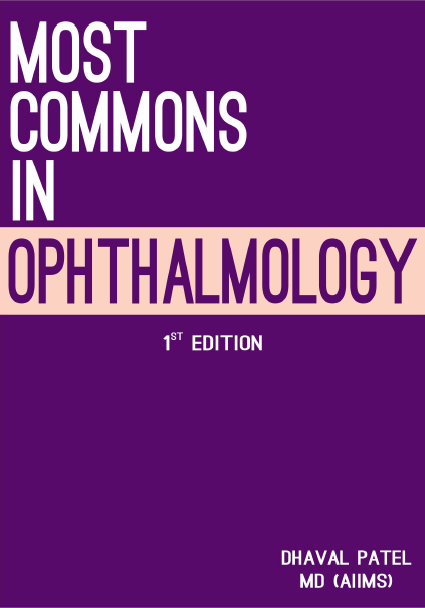
Most Commons in Ophthalmology
Last updated: September 2026
“Most Commons” has always been the hot topic which helps in solving many direct and indirect questions in entrance examinations and also clears many fundamentals related to subject. During my ophthalmology residency at AIIMS, New Delhi, I have started gathering relevant text which has helped me to compile a huge collection of most commons and has now taken the form of this book.
Time taken to compile this book is really enormous and I have tried not to leave any topic untouched. More than 1000 ophthalmology related books has been reviewed to compile this huge list of more than 4000 “most commons”. I have permitted myself to allow few duplications of most commons, it is just in the view of getting all relevant material under single heading. This Text, in a concise manner, relays information related to all major topics in ophthalmology. Additionally, it also reviews all areas commonly covered in PG and Post-PG Entrance examinations of ophthalmology.
Science is an ever changing dynamic filed and medicine is no more exception. Though each and every data collected and given here is checked for its correctness, some of the facts like percentage etc may change as new research goes on. I have taken utmost care to present the information in its latest form.
I hope readers will welcome my this text just as my previous texts like Ophthalmonics, Ophthalmology Explorer and I-Notes for which I still continue to receive appreciation emails and messages.
Most Commons in OphthalmologyA starter sample: high-yield "Most Commons" across subspecialties
| Category | Most common |
|---|---|
| Most common primary intraocular malignancy in adults | Choroidal melanoma |
| Most common primary intraocular malignancy in children | Retinoblastoma |
| Most common cause of leukocoria overall | Retinoblastoma (in referred tertiary-center series) |
| Most common cause of blindness worldwide | Cataract |
| Most common cause of irreversible blindness worldwide | Glaucoma |
| Most common type of glaucoma | Primary open-angle glaucoma |
| Most common corneal dystrophy | Fuchs endothelial corneal dystrophy — see our dedicated page |
| Most common organism in bacterial keratitis | Pseudomonas aeruginosa (varies by region/population) — see our Microbial Keratitis page |
| Most common fungal keratitis organism | Fusarium species (in warm, humid, agricultural regions) |
| Most common cause of unilateral proptosis in adults | Thyroid eye disease (Graves' ophthalmopathy) |
| Most common orbital malignancy in children | Rhabdomyosarcoma |
| Most common primary orbital malignancy in adults | Lymphoma |
| Most common cause of a red eye seen in primary care | Conjunctivitis |
| Most common cause of epiphora in infants | Congenital nasolacrimal duct obstruction — see our dedicated page |
| Most common ocular finding in neurofibromatosis type 1 | Lisch nodules (iris hamartomas) |
| Most common cause of anterior uveitis overall | Idiopathic (no identifiable cause found in the majority of cases) |
| Most common systemic association of anterior uveitis (when a cause is found) | HLA-B27-associated disease (ankylosing spondylitis, reactive arthritis, IBD-associated) |
| Most common cause of panuveitis in endemic regions | Behçet's disease (in the Middle East/East Asia) — see our dedicated page |
| Most common vitreoretinal malignancy masquerading as uveitis | Primary vitreoretinal lymphoma — see our Masquerade Syndromes page |
| Most common cause of acquired nystagmus in adults | Multiple sclerosis (for acquired pendular nystagmus specifically) |
| Most common cause of a relative afferent pupillary defect | Optic neuropathy (of any cause) — unilateral or markedly asymmetric |
This is a small sample reflecting the spirit of the full collection — the complete book contains over 4,000 entries across every ophthalmic subspecialty.
📘 Want the exam-ready deep dive? This topic, and much more is covered in Ophthalmology Explorer (A High-Yield Clinical Reference for Ophthalmology Residents, Fellows & Board Exams) — available on Kindle. See all my books.
Experiencing symptoms like these? Learn about our Eye Department or book a consultation with Dr. Dhaval Patel.