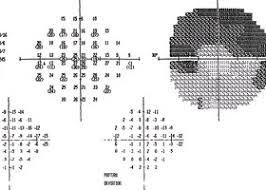
Perimetry Algorythms
Last updated: September 2026
Automated perimetry has gone through several generations of algorithm design, each aimed at the same core tension: get a reliable threshold measurement without exhausting the patient. Understanding this progression — including the most recent additions — matters both for exams and for choosing the right test in clinic.
Evolution of threshold strategies
- 1st generation — threshold determined simply by altering stimulus intensity from infra- or supra-luminal until threshold was crossed
- 2nd generation — Standard Full Threshold — staircase method; thresholds determined by an up-down 4-2dB staircase at each point; no prior probability model, so testing is slow
- 3rd generation — SITA (Swedish Interactive Threshold Algorithm) — uses a prior probability model of thresholds based on age-corrected normal and glaucomatous population data, plus an information index to determine testing endpoints faster, with fewer catch trials and improved post-test statistical modeling for sensitivity and reproducibility
Common test patterns
- 30-2 — central 30°, points 6° apart (offset 3° from horizontal/vertical axes), 76 locations
- 24-2 — central 24°, same 6° grid spacing, 54 locations
- 10-2 — 68 locations spaced 2° apart within the central 10° — used to characterize central defects in more detail
- Macula test — a 16-point, 2°-spaced grid centered on fixation, used to monitor the central field in advanced glaucoma
SITA Standard vs. SITA Fast
| SITA Fast | SITA Standard |
|---|---|
| Threshold determined via a 4-2dB step staircase at 4 primary points first; a single 4dB reversal staircase used if a second staircase deviates >12dB from the expected value | Full staircase with two reversals at every point |
| Stimulus sequence interrupted earlier (higher ERF cutoff) | Standard cutoff |
| Faster, but lower accuracy than Standard | More accurate, takes longer |
Current addition: SITA Faster and the 24-2C grid
SITA Faster is a newer refinement beyond SITA Fast, and is now widely used in current clinical practice:
- Roughly 191 seconds average test time vs. ~276 seconds for SITA Fast and ~420 seconds for SITA Standard in comparative studies — a substantial further reduction in patient burden
- Produces sensitivity outputs broadly similar to SITA Standard and Fast, though it may not be fully interchangeable with SITA Standard in eyes with more severe visual field loss — worth keeping this caveat in mind when comparing serial fields across algorithm changes in the same patient
- 24-2C grid: combines the standard 24-2 pattern with 10 additional central points drawn from the 10-2 grid — this catches central visual field defects that a plain 24-2 can miss, without needing to run a separate 10-2 test
- Current comparative evidence (2024-2026) finds 24-2C with SITA Faster detects central defects in mild-stage glaucoma more effectively than 24-2 SITA Standard, and performs comparably to (though not perfectly interchangeably with) a full 10-2 SITA Standard test — while taking meaningfully less time than running both 24-2 and 10-2 separately
- Practical implication: 24-2C SITA Faster is increasingly considered a reasonable default for patients where central field involvement is a concern, rather than needing to add a separate 10-2 test in every case
Definitions worth remembering
Threshold sensitivity is defined as the stimulus intensity to which the patient responds 50% of the time.
Key references: Heijl A, et al. A new SITA perimetric threshold testing algorithm. | Nishijima E, et al. Comparative analysis of 24-2C, 24-2, and 10-2 visual field tests. Am J Ophthalmol. 2024. | Pham AT, et al. The effect of transitioning from SITA Standard to SITA Faster on visual field performance. Ophthalmology. 2021.
📘 Want the exam-ready deep dive? This topic is covered in iNotes 2027: Glaucoma (Ophthalmology Postgraduate Exam Notes) — available on Kindle. See all my books.
Want to know more about treatment? Read about Glaucoma Treatment at Sadbhaav or book a consultation with Dr. Dhaval Patel.