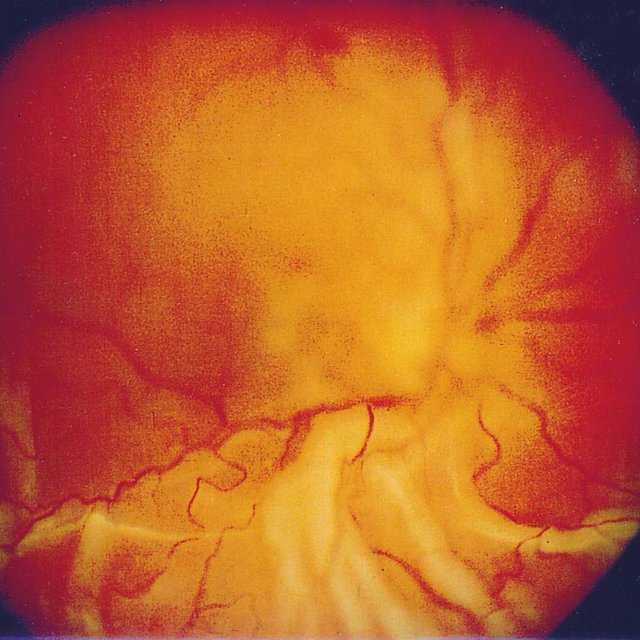
Proliferative Vitreoretinopathy
Last updated: September 2026
Proliferative vitreoretinopathy (PVR) is the most common cause of surgical failure after rhegmatogenous retinal detachment (RRD) repair — complicating roughly 5-10% of primary RRD cases and up to half of open-globe trauma-related detachments. It results from contractile fibrocellular membranes forming in the vitreous and on both retinal surfaces, causing tractional re-detachment with fixed retinal folds.
Classification (updated Retina Society, 1991) — still the current standard
| Grade | Findings |
|---|---|
| A — Minimal | Vitreous haze, pigment clumps in the vitreous and on the inferior retina |
| B — Moderate | Wrinkling of the inner retinal surface, retinal vessel tortuosity, rolled/irregular edge of a retinal break, decreased retinal mobility |
| C — Marked | Fixed retinal folds, further subdivided by location (anterior/posterior) and extent by number of clock hours involved |
| D — Massive | Fixed, wide retinal folds in all four quadrants ("napkin ring" configuration) |
A practical note for residents: audits of the retina literature find the updated Retina Society classification is inconsistently applied even in published series — often used without a full description of Grade C subtype, and sometimes with outright classification errors. Precision in describing PVR grade matters both for surgical planning and for genuinely comparable outcome reporting.
Current direction: earlier, more objective staging
- Swept-source OCT (SS-OCT) is emerging as a tool to characterize PVR at a microstructural level — outer retinal corrugations (ORCs) on OCT correlate with clinical PVR grade, and high-amplitude ORCs are specifically associated with PVR grade B/C, offering a more objective, reproducible staging adjunct to clinical grading alone
- This OCT-based approach is part of a broader push to move beyond subjective clinical grading toward reproducible imaging biomarkers
Management principles
- Early surgical intervention remains the only proven strategy to reduce PVR incidence — timely primary RRD repair matters as much for preventing PVR as for reattaching the retina
- Surgical management of established PVR centers on relieving all tractional membranes (membrane peeling, relaxing retinotomy/retinectomy where needed) combined with adequate tamponade — silicone oil is frequently favored for its prolonged tamponade effect in complex PVR cases
- Adjunctive human amniotic membrane patching has been studied to reinforce complex retinal detachment repairs complicated by postoperative PVR
Pharmacological adjuncts (still investigational)
No non-surgical treatment for PVR is yet established in routine clinical practice, despite ongoing research interest. Agents studied include intravitreal methotrexate, 5-fluorouracil, corticosteroids, and anti-VEGF agents — a 2023-2024 systematic review found the current randomized controlled trial evidence for non-surgical PVR prevention/treatment remains limited, underscoring that surgery remains the only reliably effective intervention today.
Key references: Proliferative Vitreoretinopathy, EyeWiki (2024). | Assessment of PVR in RRD with OCT. Ophthalmol Retina. 2025. | Desideri LF, et al. PVR: an update on current and emerging treatment options. Graefes Arch Clin Exp Ophthalmol. 2024;262(3):677.
📘 Want the exam-ready deep dive? This topic, and much more is covered in Ophthalmology Explorer (A High-Yield Clinical Reference for Ophthalmology Residents, Fellows & Board Exams) — available on Kindle. See all my books.
Want to know more about treatment? Read about Retina Treatment at Sadbhaav or book a consultation with Dr. Dhaval Patel.