Ratios in Ophthalmology
Last updated: September 2026
Kestenbaum's Index (corrected)
The Kestenbaum capillary number index is the number of small vessels/capillaries crossing the optic disc margin — counted starting at the 12 o'clock position, going around the full circumference:
- Normal count: approximately 10 (classically described as ~9 large vessels [4-5 veins + 4-5 arteries] plus ~10 small vessels, without pupil dilation)
- Optic atrophy: count reduces to fewer than 6
- Hyperemic disc: count exceeds 12
First described by Alfred Kestenbaum in 1947, this remains a simple, no-equipment bedside way to help quantify borderline optic atrophy.
Cup-Disc Ratio
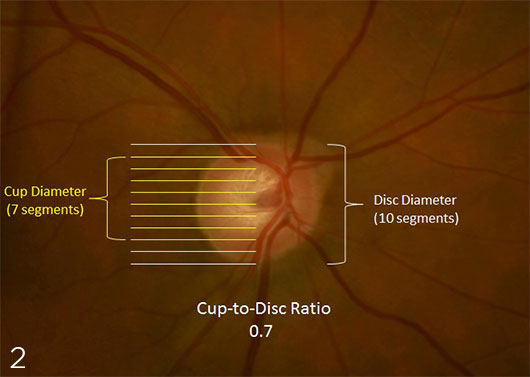
Normal cup-disc ratio averages around 0.3, with wide physiological variation (up to 0.5-0.6 can be normal in an otherwise healthy, large disc).
- A large cup may be physiological (especially in large discs) or glaucomatous — asymmetry between the two eyes (>0.2 difference) is a more reliable red flag than an isolated large cup
- The cup enlarges/deepens with progressive glaucomatous damage
- The disc becomes "full" (cup obscured) in papilledema and papillitis, since swelling fills in the physiological cup
Arden Ratio (EOG)
Arden ratio = (light peak / dark trough) × 100, from electro-oculography:
- ≥185 (i.e., ≥1.85): normal
- 150-184 (1.50-1.84): subnormal
- <125 (<1.25): flat/significantly subnormal
Severely reduced in Best vitelliform macular dystrophy — see our Electro-Oculography page for the full clinical significance of this test.
Arteriovenous (A:V) Ratio
Normal retinal arteriole:venule caliber ratio is roughly 2:3. Deviations are clinically meaningful:
- Arteriolar narrowing: hypertensive retinopathy, arteriosclerosis, central retinal artery occlusion
- Venous tortuosity: diabetes mellitus, central retinal vein occlusion, blood dyscrasias (e.g., polycythemia, hyperviscosity states)
- Vascular sheathing: periphlebitis retinae, hypertensive retinopathy
A few more high-yield ratios
- AC/A ratio (accommodative convergence to accommodation): normal is roughly 3-5 prism diopters of convergence per diopter of accommodation. A high AC/A ratio is central to the diagnosis and management of accommodative esotropia and convergence excess
- Rim-to-disc ratio (used in the ISNT rule): the healthy neuroretinal rim is normally thickest Inferiorly, then Superiorly, then Nasally, then Temporally (I > S > N > T). Violation of this pattern is an early, subtle sign of glaucomatous damage, often preceding a frankly enlarged cup-disc ratio
- Axial length to corneal diameter ratio — a supportive clue in congenital glaucoma workup, since disproportionate globe enlargement (buphthalmos) reflects sustained elevated IOP in the pre-fusion sclera
Key reference: Kestenbaum Index, EyeWiki (2025).
📘 Want the exam-ready deep dive? This topic is covered in iNotes 2027: Basic Science & Optics (Ophthalmology Postgraduate Exam Notes) — available on Kindle. See all my books.
Experiencing symptoms like these? Learn about our Eye Department or book a consultation with Dr. Dhaval Patel.