Visual Impairment Categories: 6/60, 3/60 & 20/60 Explained
Looking for a simpler explanation? Read our patient guides on what 6/60, 3/60 and 1/60 vision mean or levels of visual impairment and legal blindness, in plain language.
Last updated: September 2026
Important: India's legal definition of blindness changed in 2017 — this page reflects the current definition under the Rights of Persons with Disabilities (RPwD) Act, 2016, which replaced the older 1995 Act. If you trained on or remember the older 6/60 cutoff, note that the threshold is now stricter.
Current definition of blindness (RPwD Act, 2016)
A person is certified as blind if, after best correction, they have any of the following:
- Total absence of sight; or
- Visual acuity less than 3/60 (or less than 10/200 Snellen) in the better eye; or
- Limitation of the field of vision subtending an angle of less than 10 degrees
This is stricter than the older 1995 Act criterion, which set the threshold at visual acuity not exceeding 6/60 (20/200) or a field of 20 degrees or worse.
Current definition of low vision (RPwD Act, 2016)
A person has low vision if, with best possible correction, they have any of the following:
- Visual acuity not exceeding 6/18, or less than 20/60, down to 3/60 (or up to 10/200 Snellen) in the better eye; or
- Limitation of the field of vision subtending an angle of less than 40 degrees, down to 10 degrees
Why this matters practically
The RPwD Act, 2016 replaced the 1995 Persons with Disabilities Act and expanded recognized disabilities from 7 to 21 categories (blindness and low vision remain two of them). This is the legally operative definition today for disability certification, benefits eligibility (reservations in education and employment, free public transport, examination scribe assistance, and other statutory benefits), and any current medical board assessment in India — not the older 1995 criteria some textbooks and older references still cite.
WHO definition, for comparison
The World Health Organization's ICD-11-based definition differs again: a person is visually impaired if presenting visual acuity in the better eye is worse than 3/60, with near vision impairment now also included (presenting near VA worse than N6 with correction). Note that India's National Programme for Control of Blindness (NPCB) historically used yet another threshold (20/200) based on presenting rather than best-corrected acuity — so when discussing "blindness," always be explicit about which definition (RPwD 2016, WHO/ICD-11, or NPCB) is being used, since the numbers genuinely differ.
US definition (20/XX notation), for comparison
If you're used to the American 20/XX Snellen notation rather than India's 6/XX metric system, here's the direct equivalent — both measure the exact same thing, just at different testing distances (20 feet vs. 6 metres):
| US (feet) | India/UK (metres) | Meaning |
|---|---|---|
| 20/20 | 6/6 | Normal vision |
| 20/40 | 6/12 | Mild impairment |
| 20/60 | 6/18 | Mild-moderate impairment |
| 20/100 | 6/30 | Moderate impairment |
| 20/200 | 6/60 | Severe impairment / US legal blindness threshold |
| 20/400 | 6/120 | Profound impairment |
In the United States, the Social Security Administration defines legal blindness as visual acuity of 20/200 or worse in the better eye with best correction (equivalent to 6/60), or a visual field of 20 degrees or less in the better eye — this is the operative US definition for disability benefits, distinct from both India's RPwD 2016 threshold (3/60) and the WHO/ICD-11 threshold.
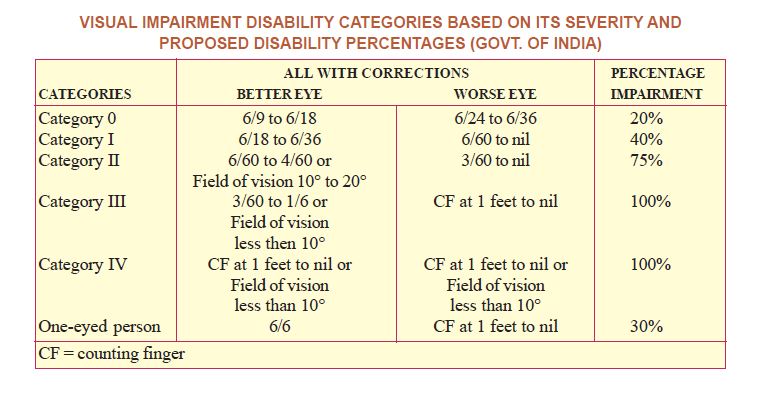
Categories of visual correction/impairment for certification
| Category | Better eye | Worse eye | % Disability |
|---|---|---|---|
| I | 6/18-6/36 | 6/24 to Nil | 40% |
| II | 6/40-4/60 or field 10-20° | 3/60 to Nil | 75% |
| III | 3/60 to 1/60 or field <10° | F.C. at 1ft to Nil | 100% |
| IV | F.C. at 1ft to Nil or field <10° | F.C. at 1ft to Nil | 100% |
| One-eyed person | 6/6 | F.C. at 1ft to Nil or field <10° | 30% |
F.C. = Finger Count. This categorization framework guides percentage disability certification — always verify against the current gazette notification when issuing an actual certificate, as specific percentage assignments are periodically updated by the Ministry of Social Justice and Empowerment.
Key references: The Rights of Persons with Disabilities Act, 2016 (India). | Ministry of Social Justice and Empowerment, Guidelines for Assessment of Visual Disability. | Understanding definitions of visual impairment and functional vision. Community Eye Health J.
📘 Want the exam-ready deep dive? This topic, and much more is covered in Ophthalmology Explorer (A High-Yield Clinical Reference for Ophthalmology Residents, Fellows & Board Exams) — available on Kindle. See all my books.
Want to know more about treatment? Read about Squint Treatment at Sadbhaav or book a consultation with Dr. Dhaval Patel.