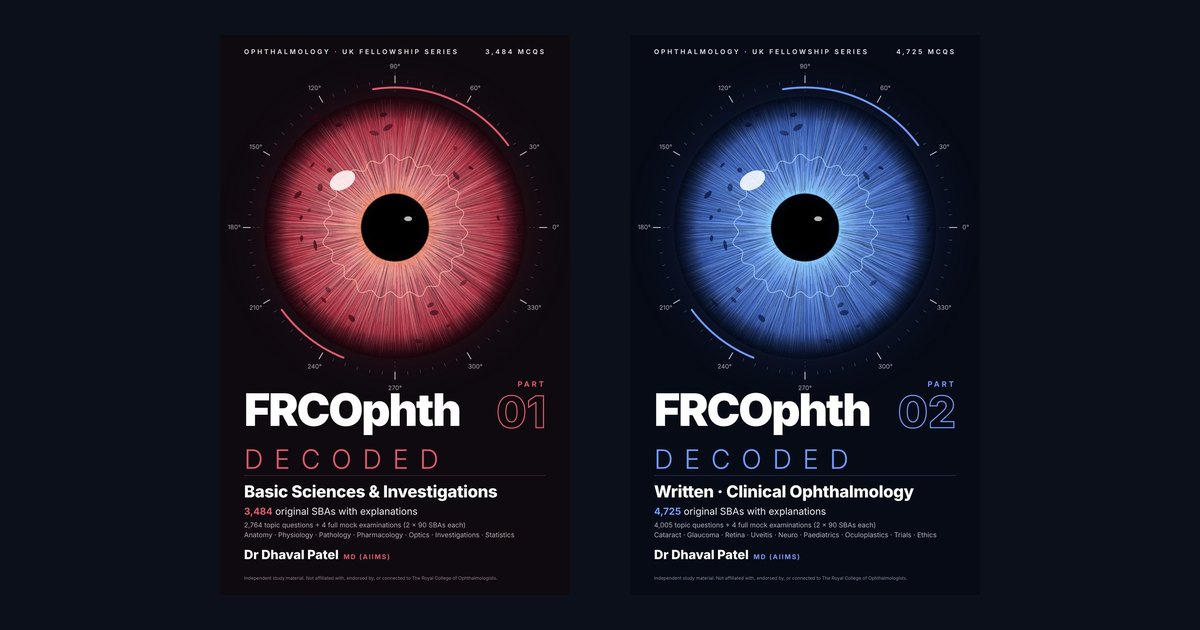
FRCOphth Decoded: Part 1 and Part 2 Written Question Banks (8,209 SBAs)
Last updated: November 2026
FRCOphth Decoded is a two-part question bank for the Fellowship examinations of The Royal College of Ophthalmologists, written by Dr Dhaval Patel, MD (AIIMS). Together the two books hold 8,209 original single-best-answer questions, each with the reasoning behind the answer, a reason why every other option is wrong, and a one-line pearl to revise from.
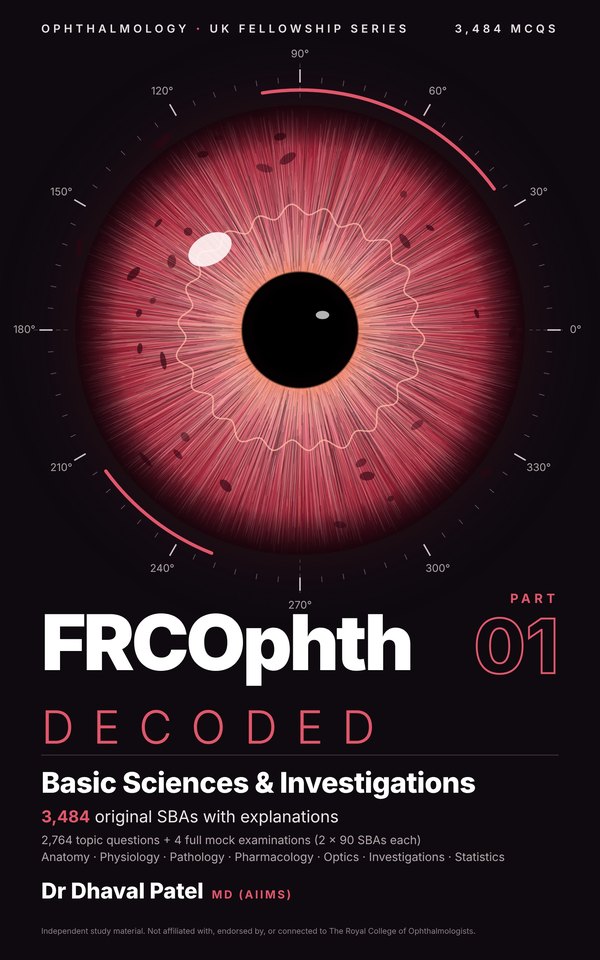
Part 1 Decoded: Basic Sciences & Investigations
3,484 original SBAs: 2,764 topic questions in 14 chapters + 4 full mock examinations (2 × 90 SBAs each).
Anatomy, embryology, physiology, biochemistry, pathology, microbiology, immunology, genetics, pharmacology, optics and refraction, lasers and instruments, investigations, statistics and ethics.
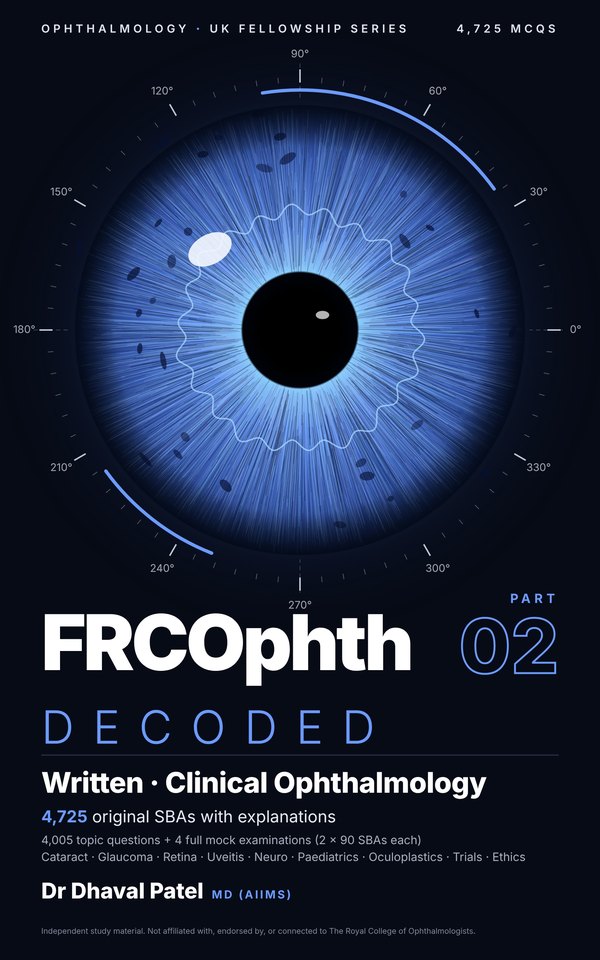
Part 2 Written Decoded: Clinical Ophthalmology
4,725 original SBAs: 4,005 clinical topic questions in 15 chapters + 4 full mock examinations (2 × 90 SBAs each).
Cataract, glaucoma, cornea, medical retina, vitreoretinal and trauma, uveitis, neuro-ophthalmology, paediatrics and strabismus, oculoplastics and oncology, refractive surgery, landmark trials, NICE and RCOphth guidance, statistics and ethics.
What makes it different
- Every option explained. Each question has an explanation, a "Why not" line for each wrong option, and a pearl. In single-best-answer papers it is the distractors that cost marks.
- Built around the syllabus. Part 1 follows the basic-science syllabus in 14 chapters and 107 subtopics. Part 2 follows the clinical curriculum in 15 chapters and 100 subtopics, and was checked against a 2,600-term curriculum list.
- Eight full mock examinations (four per book), each 180 questions in two papers of 90, blueprinted to the weighting of the real exam. No mock question repeats a topic question.
- Landmark trials and guidance decoded in Part 2: OHTS, EMGT, UKGTS, LiGHT, EAGLE, DRCR protocols, CATT/IVAN, LEAVO, EVS, ONTT, IIHTT, PEDIG, SYCAMORE and more, with NICE NG77, NG81 and NG82 and RCOphth guidance.
- Tagged for planning. Difficulty levels (D1 recall, D2 application, D3 advanced) and high-yield flags, plus a High-Yield Pearls Index in Part 1.
- Original. No question is taken from any College paper.
Who is it for?
- Candidates sitting FRCOphth Part 1 and Part 2 Written.
- Trainees preparing for ICO Basic Science and Clinical Sciences, FEBO, FRANZCO, FCOphth and MRCSEd Ophth.
- Residents and fellows anywhere who want one complete basic-science bank (Part 1) and one complete clinical bank (Part 2).
Sample questions
From Part 1 Decoded · Anatomy
In a pure orbital blow-out fracture, the floor usually breaks medial to the:
- Inferior orbital fissure
- Lacrimal fossa
- Infraorbital groove and canal
- Zygomaticomaxillary suture
Show answer and explanation
Answer: C. The floor is weakest just medial to the infraorbital groove, where the bone is thinnest over the maxillary sinus. Fractures here often damage the infraorbital nerve, causing numbness of the cheek and upper lip.
Why not: A — The fissure lies posterolaterally and is not the usual fracture line. B — The lacrimal fossa lies in the medial wall, not the floor. D — A fracture there implies a zygomatic complex fracture, not a pure blow-out.
Pearl: Cheek and upper lip numbness after blunt orbital trauma suggests a floor fracture involving the infraorbital nerve.
From Part 2 Written Decoded · Cataract
A 72-year-old man is listed for right cataract surgery. Optical biometry gives axial lengths of 23.4 mm (right) and 24.6 mm (left). His refraction is right −0.50 DS and left −0.75 DS. What is the most appropriate next step?
- Repeat biometry on both eyes, as the inter-eye difference is not explained by the refraction
- Proceed using the right eye measurement
- Use the average of both eyes
- Switch to contact ultrasound biometry
Show answer and explanation
Answer: A. Royal College guidance recommends repeating measurements when axial lengths differ by more than 0.3 mm between eyes, unless the refractive difference explains it. A 1.2 mm difference would normally give about 3.5 D of anisometropia.
Why not: B — A >0.3 mm inter-eye difference without matching anisometropia must be checked first. C — Averaging hides a possible error. D — Repeat optical biometry first; switch only if it fails.
Pearl: Also recheck if K readings differ by >0.9 D between eyes or are outside 41–47 D.
Try 10 free questions from Part 1
One question from each of ten chapters. Tap an answer to see the explanation.
Try 10 free questions from Part 2
One question from each of ten chapters.
For a timed paper, take the free FRCOphth Part 1 and ICO basic sciences mock or the FRCOphth Part 2 Written mock, or see all free mock tests.
The Decoded series
Every Decoded book follows the same method: an original question, the reasoning behind the answer, why each wrong option is wrong, and a pearl.
| Book | Examination | Status |
|---|---|---|
| OKAT Decoded (3 volumes, 10,200 MCQs) | AIOS-OKAT (India) | Available |
| FRCOphth Part 1 Decoded (3,484 SBAs) | FRCOphth Part 1 (UK) | Available |
| FRCOphth Part 2 Written Decoded (4,725 SBAs) | FRCOphth Part 2 Written (UK) | Available |
| ICO Decoded | ICO examinations | Coming soon |
| FEBO Decoded | European Board of Ophthalmology | Coming soon |
| OKAP Decoded | OKAP and ABO (USA) | Coming soon |
Suggested way to work
- Work through the topic chapters one at a time. Commit to an answer before reading the explanation, and mark every question you get wrong or guess.
- Read the "Why not" lines even when you are right.
- Review marked questions a week later. Keep the pearls for the final week.
- Sit the four mock examinations under timed conditions once the chapters are done.
Frequently asked questions
Can I buy the books outside India? Yes. Both are Kindle books, so use the Amazon UK or US link above, or search the title on your own country's Amazon store.
Do I need both parts? Each stands alone. Part 1 is for the basic-science exam; Part 2 Written is for the clinical exam and is also useful for exit examinations such as FEBO and ICO Clinical Sciences.
How do I report an error? Email [email protected]. Corrections are welcome for future editions.
See also: ophthalmology exams abroad, OKAP, FRCOphth and ICO exam formats, about the author and all books by Dr Dhaval Patel.
Independent study material. Not affiliated with, endorsed by, or connected to The Royal College of Ophthalmologists. "FRCOphth" is used only to identify the examinations these books prepare for. All questions are original. Candidates should confirm the current examination format with the College.
📘 Want more exam-ready material? See Most Commons in Ophthalmology on Kindle, or browse all my books.
Looking for an eye specialist in Ahmedabad? Learn about our Eye Department or book a consultation with Dr. Dhaval Patel.