OKAT Decoded: 10,200 Original MCQs for AIOS-OKAT in 3 Volumes
Last updated: October 2026
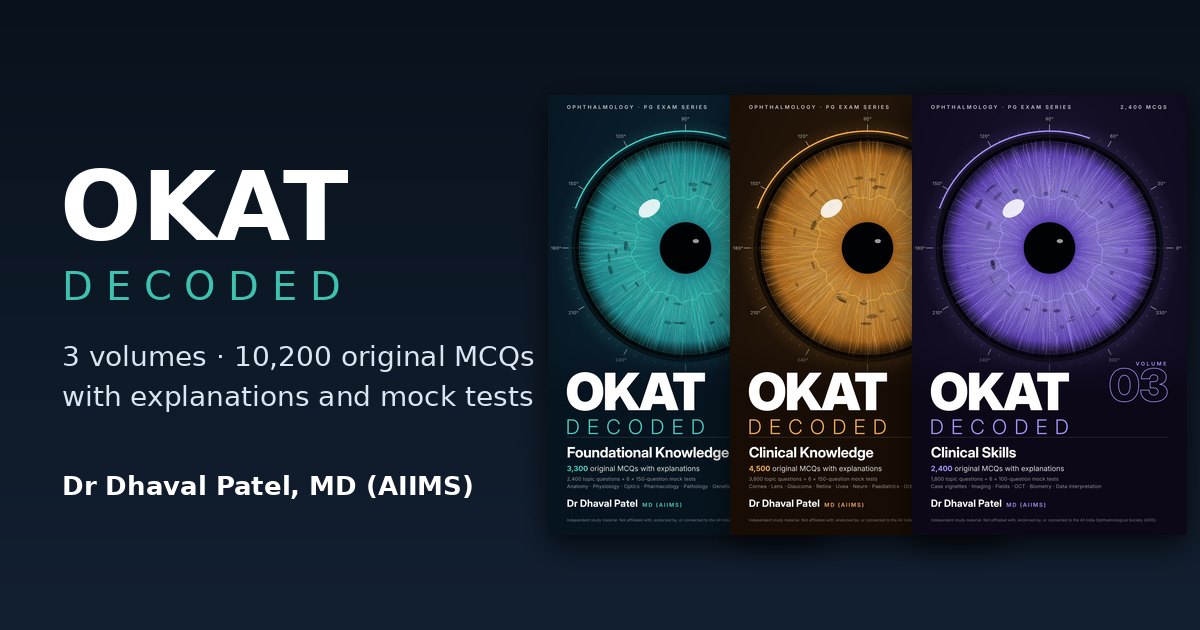
OKAT Decoded is a three-volume question bank for the AIOS-OKAT and other postgraduate ophthalmology examinations, written by Dr Dhaval Patel, MD (AIIMS). It contains 10,200 original multiple-choice questions, each with the reasoning behind the answer, a reason why every other option is wrong, and a pearl worth remembering.
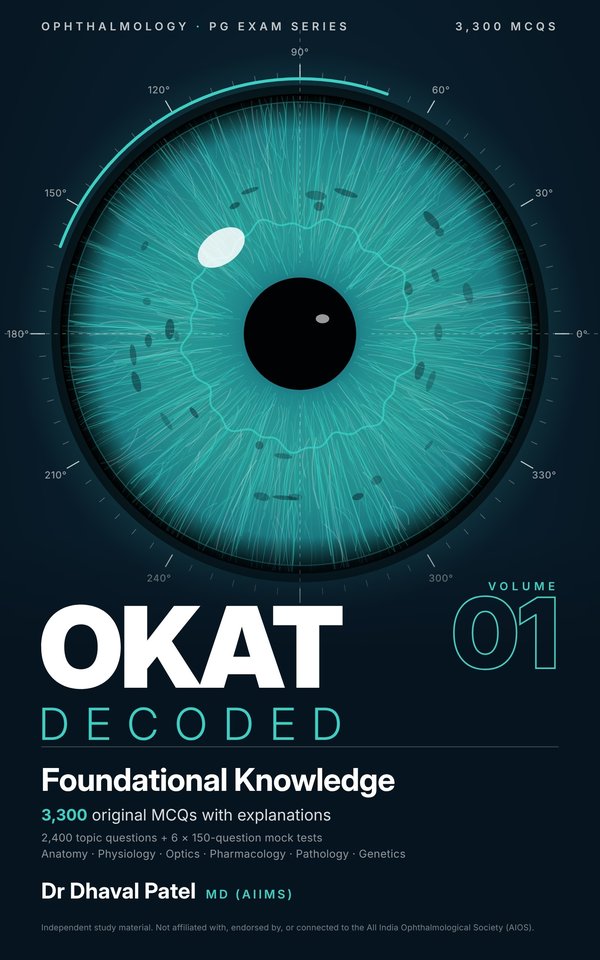
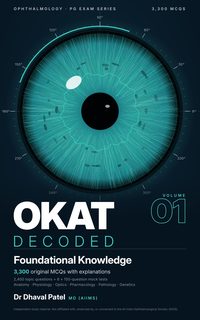
Volume 1: Foundational Knowledge
3,300 original MCQs: 2,400 topic questions + 6 × 150-question mock tests.
Anatomy, embryology, physiology, biochemistry, pathology, microbiology, immunology, genetics, pharmacology, optics, refraction, investigations and biostatistics.
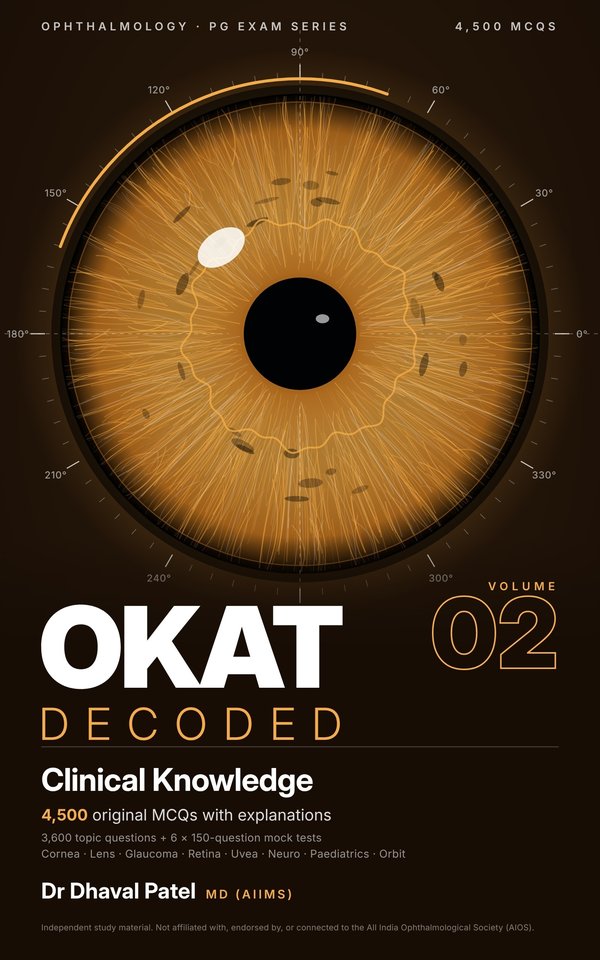
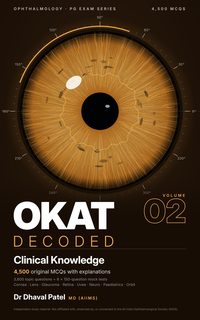
Volume 2: Clinical Knowledge
4,500 original MCQs: 3,600 topic questions + 6 × 150-question mock tests.
Lids, lacrimal, orbit, conjunctiva, cornea, refractive surgery, sclera, lens and cataract, glaucoma, uvea, medical retina, vitreoretinal surgery, neuro-ophthalmology, paediatrics, strabismus, oncology, trauma, systemic disease and community ophthalmology.
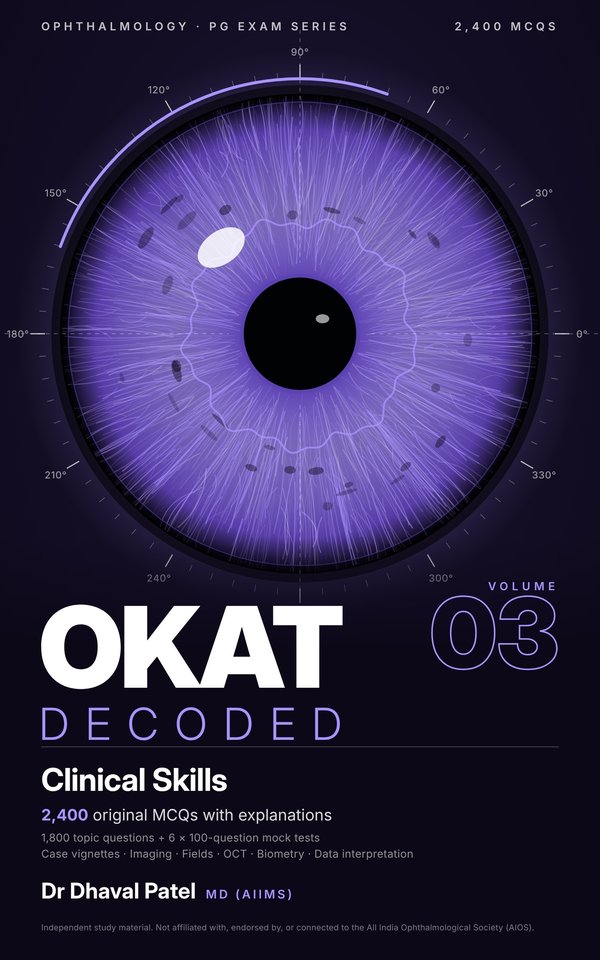
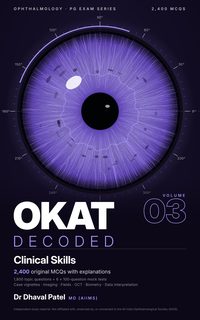
Volume 3: Clinical Skills
2,400 original MCQs: 1,800 topic questions + 6 × 100-question mock tests.
Case vignettes on red eye triage, vision loss, cataract decisions, glaucoma fields and OCT, retinal imaging, uveitis work-up, neuro-ophthalmic localisation, paediatrics and strabismus, cornea, orbit, trauma and data interpretation.
What makes it different
- Explained, not just answered. Every question has an explanation, a "Why not" line for each wrong option, and a one-line pearl. The aim is to show how to reach the answer, so the next question on the topic is easier however it is worded.
- Organised like the exam. Volume 1 covers the foundations (OKAT Module 1), Volume 2 clinical knowledge in every subspecialty, and Volume 3 case-based clinical skills and data interpretation.
- Tagged for planning. Each question carries a chapter code, the training year by which it is usually expected (PGY1–3) and a difficulty level (D1 recall, D2 application, D3 advanced).
- 18 full-length mock tests across the three volumes, to practise under exam conditions once the chapters are done.
- Original and current. No question is taken from any OKAT paper. Explanations name the landmark trial or classification behind the answer, with British spelling and international drug names.
A sample question
Excision of the palpebral lobe of the lacrimal gland causes a dry eye because:
- The palpebral lobe produces most of the tears
- The ducts of the orbital lobe pass through the palpebral lobe
- It damages the lacrimal nerve
- It removes the accessory lacrimal glands
Show answer and explanation
Answer: B. The lateral horn of the levator aponeurosis divides the gland into orbital and palpebral lobes. The ducts of the larger orbital lobe pass through the palpebral lobe to the fornix, so removing the palpebral lobe effectively cuts off both.
Why not: A — the orbital lobe is larger. C — the lacrimal nerve enters from behind. D — the accessory glands lie in the fornix and tarsal border.
Pearl: Never biopsy the palpebral lobe casually. A lacrimal gland mass should be approached through the orbital lobe or by excision with a proper plan.
Try before you buy
Take a free, timed 50-question mock drawn from each volume:
- Volume 1 sample mock: Foundational Knowledge
- Volume 2 sample mock: Clinical Knowledge
- Volume 3 sample mock: Clinical Skills
Suggested way to work
- Work chapter by chapter. Commit to an answer before reading the explanation, and mark every question you get wrong or guess.
- Read the "Why not" lines even when you are right; most traps sit in the wrong options.
- Review marked questions a week later and again before the exam. The pearls make a quick last-minute revision list.
- Sit the mock tests under timed conditions (about one minute per question) after covering the chapters.
Frequently asked questions
Is it only for the OKAT? No. The content follows the postgraduate ophthalmology curriculum, so it also suits MS and DNB residents, FRCOphth and ICO candidates, and anyone revising for an in-training exam.
Can I use one volume on its own? Yes. Each volume stands alone; together they move from basic science to clinical decisions.
How do I report an error or suggest a change? Email [email protected]. Corrections are welcome for future editions.
See also: AIOS-OKAT exam guide, all free mock tests and all books by Dr Dhaval Patel.
Independent study material. Not affiliated with, endorsed by, or connected to the All India Ophthalmological Society (AIOS). "OKAT" is used only to identify the examination these books prepare for. All questions are original and are not taken from any OKAT paper.
📘 Want more exam-ready material? See Most Commons in Ophthalmology on Kindle, or browse all my books.
Looking for an eye specialist in Ahmedabad? Learn about our Eye Department or book a consultation with Dr. Dhaval Patel.