OphthalMIND: 1,188 Ophthalmology Puzzles for PG Exams and Quizzes (Free Sample Puzzles)
For: PG residents · Practising ophthalmologists
Last updated: November 2026
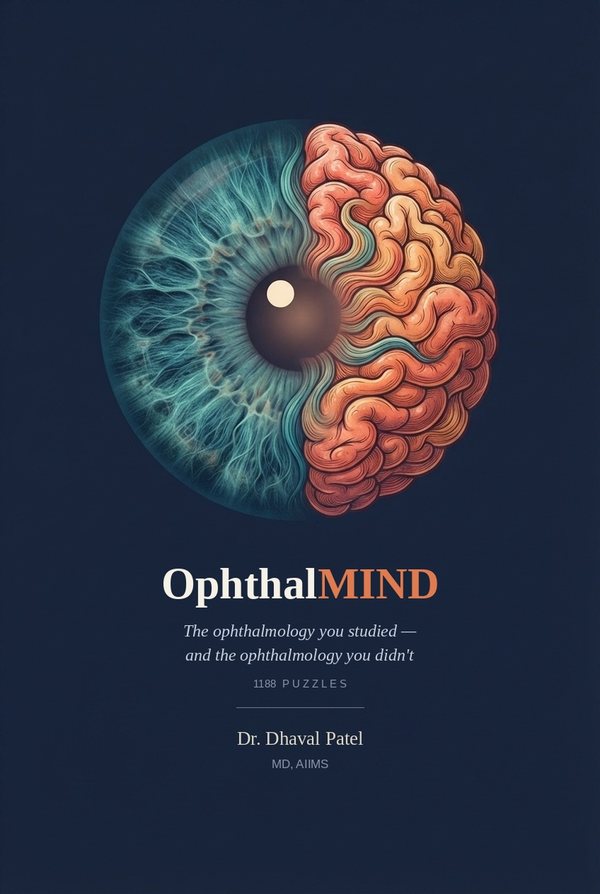
The questions that really sharpen a clinician rarely look like a standard MCQ bank. OphthalMIND collects 1,188 of them: puzzles that connect facts across subspecialties, reward reasoning over recall, and occasionally surprise you. It grew out of years of preparing residents for exams and conference quizzes, after Dr Dhaval Patel won an ophthalmology society quiz in 2012.
- 1,188 puzzles in 15 chapters, each rated ★ to ★★★
- Case-crackers, sequences, match-the-pairs, odd-one-out, number and word puzzles, integrative questions
- Chapters 1–14: the clinical core, from instruments and basic sciences to community ophthalmology
- Chapter 15: ophthalmology in unexpected places: history, Nobel science, art, sport and politics
- Answer keys after every chapter, with the reasoning, not just the letter
Kindle edition, by Dr Dhaval Patel, MD (AIIMS). Read on any phone, tablet or computer with the free Kindle app.
Amazon links are affiliate links; Sadbhaav Eye Clinic may earn a small commission at no extra cost to you.
The 15 chapters
| Chapter | Topic |
|---|---|
| 1 | Ophthalmic instruments: eponyms and origins |
| 2 | Pioneers of ophthalmology |
| 3 | Basic sciences (anatomy and physiology) |
| 4 | Optics and refraction |
| 5 | Cornea and external disease |
| 6 | Lens and cataract |
| 7 | Glaucoma |
| 8 | Neuro-ophthalmology |
| 9 | Strabismus and paediatric ophthalmology |
| 10 | Retina and vitreous |
| 11 | Uvea |
| 12 | Oculoplasty and orbit |
| 13 | Community ophthalmology |
| 14 | Miscellaneous (cross-subspecialty) |
| 15 | Ophthalmology in unexpected places |
Seven puzzle formats
- Case-cracker: three clues, each narrowing the field, the last one decisive.
- Sequence: put steps, events or layers in the right order.
- Number and formula: work out the value and explain why it matters.
- Match-the-pairs: instruments to inventors, signs to diseases, drugs to effects.
- Odd one out: spot the item that does not belong, and say why.
- Word puzzles: unscramble the eponym from the clue.
- Integrative: multi-part questions that join several subspecialties.
Ten free puzzles from the book
Try these exactly as they appear in the book. Answer in your head (or out loud, quiz-style) before you open the answer.
Chapter 1 · Instruments: eponyms and origins · Puzzle 1.2 · ★★★ · Case-cracker
Clue 1: This instrument’s principle came from its inventor’s observation of a pattern of concentric light rings reflecting off a curved surface.
Clue 2: It projects illuminated concentric rings onto the cornea; irregular spacing between reflected rings indicates irregular corneal curvature.
Clue 3 (final): Invented in 1880 by a Portuguese ophthalmologist, it is the direct conceptual ancestor of modern computerised corneal topography. Name the instrument and its inventor.
Show the answer
Chapter 1 · Instruments: eponyms and origins · Puzzle 1.19 · ★★★ · Sequence
Arrange these diagnostic/testing milestones in chronological order of introduction.
A. Ishihara publishes his colour vision plates (1917)
B. Placido develops his corneal topography disc (1880)
C. Snellen designs his visual acuity chart (1862)
D. Goldmann introduces his applanation tonometer (1950s)
Show the answer
Chapter 3 · Basic sciences · Puzzle 3.87 · ★★★ · Case-cracker
Clue 1: This rare mitochondrial inheritance pattern means a condition is passed from an affected mother to ALL her children, but affected fathers never transmit it to any offspring.
Clue 2: Leber hereditary optic neuropathy (covered earlier in this book) follows this inheritance pattern.
Clue 3 (final): This pattern exists because mitochondria (and their DNA) are inherited almost exclusively from the egg cell’s cytoplasm, not from sperm. Name this inheritance pattern.
Show the answer
Chapter 4 · Optics and refraction (history of contact lenses) · Puzzle 4.42 · ★★★ · Case-cracker
Clue 1: This Czech chemist spent the 1950s developing a water-absorbing, transparent polymer gel at a state research institute — until a political purge forced him out of his position, cutting off his funding and institutional support.
Clue 2: Refusing to abandon his research, he continued working at home, in his kitchen, assembling an improvised lens-casting machine from his sons’ children’s metal construction toy set, powered first by a bicycle dynamo borrowed from the same sons’ bicycle, and later by a doorbell transformer providing precise, controlled rotation speed.
Clue 3 (final): On Christmas Eve, 1961, working at his kitchen table with his wife’s help, he successfully cast the world’s first four soft hydrogel contact lenses using this improvised device — inventing both the material and the centrifugal “spin-casting” manufacturing method still conceptually underlying soft lens production today. Name this chemist, the material he invented, and the children’s construction toy brand he used to build his lens-casting machine.
Show the answer
Chapter 5 · Cornea and external disease · Puzzle 5.25 · ★★★ · Case-cracker
Clue 1: This organism, a free-living amphizoic protozoan, can exist in both a motile trophozoite form and a highly resistant, dormant cyst form.
Clue 2: Its cyst form is notoriously resistant to many standard disinfection methods, including some contact lens solutions previously believed adequate.
Clue 3 (final): Diagnosis is often confirmed by confocal microscopy showing characteristic double-walled cysts, or by culture on a non-nutrient agar overlaid with a specific bacterial food source. Name the organism, and name the type of agar/culture technique used for diagnosis.
Show the answer
Chapter 6 · Lens and cataract · Puzzle 6.57 · ★★★ · Case-cracker
Clue 1: A patient with a retained intraocular metallic foreign body develops progressive rust- brown discoloration of the iris and a fine granular cataract over months to years.
Clue 2: Electroretinography shows progressively diminishing photoreceptor function.
Clue 3 (final): This is caused by chronic toxic deposition of a specific metal, distinct from the (often better-tolerated) chalcosis caused by retained copper foreign bodies. Name this condition and the metal responsible.
Show the answer
Chapter 7 · Glaucoma · Puzzle 7.28 · ★★★ · Case-cracker
Clue 1: A child presents with a facial port-wine stain in the distribution of the trigeminal nerve’s first (ophthalmic) division.
Clue 2: On the same side, glaucoma is present, often congenital or early-onset, sometimes with an associated choroidal hemangioma.
Clue 3 (final): Imaging reveals a leptomeningeal vascular malformation, completing a classic neurocutaneous triad. Name this syndrome, and name the mechanism by which it causes elevated IOP.
Show the answer
Chapter 8 · Neuro-ophthalmology · Puzzle 8.24 · ★★★ · Case-cracker
Clue 1: A patient presents with an inability to voluntarily look upward, along with pupils that constrict poorly to light but constrict normally to a near target.
Clue 2: Convergence-retraction nystagmus is noted on attempted upgaze, particularly when the examiner uses an opticokinetic drum rotated downward.
Clue 3 (final): The underlying lesion is located in the dorsal midbrain, often from a pineal region tumour compressing this area in a younger patient. Name this syndrome.
Show the answer
Chapter 9 · Strabismus and paediatric ophthalmology · Puzzle 9.27 · ★★★ · Odd one out
One of these is NOT part of the classic CHARGE syndrome acronym. Identify the odd one out.
A. Coloboma
B. Heart defects
C. Choanal atresia
D. Cataract
Show the answer
Chapter 10 · Retina and vitreous · Puzzle 10.20 · ★★★ · Case-cracker
Clue 1: A young male presents with reduced vision, and OCT reveals cystic spaces splitting the retinal layers, most prominently in the macula in a spoke-wheel pattern on fundus exam.
Clue 2: Electroretinography shows a characteristically reduced b-wave with a relatively preserved a-wave (a “negative ERG” pattern).
Clue 3 (final): This X-linked condition is caused by mutations in the RS1 gene, encoding a protein called retinoschisin important for retinal cell adhesion. Name this condition.
Show the answer
Chapter 15: ophthalmology in unexpected places
The chapter that began with one question (“is there a mother of ophthalmology, the way there are so many fathers?”) and kept going. Among its stories:
- The Swedish Nobel laureate in medicine who stood in the way of Einstein’s Nobel Prize.
- The chemist who, purged from his research post, invented the soft contact lens at his kitchen table with his sons’ toy construction set (Puzzle 4.42 above gives you a taste).
- The Test cricketer who lost the sight of one eye in a car accident and became his country’s youngest captain within months.
- Kepler, who set aside the orbit of Mars to work out that the retina forms an inverted image.
- Ophthalmologists who became heads of government and health ministers, and the surgeon whose cryoprobe connects a British prime minister and a South African president.
Every story was checked as carefully as any clinical fact, and where a popular story did not hold up, the book says so.
1,178 more puzzles in the book
Use Chapters 1–14 for exam revision and Chapter 15 for your next quiz round.
Amazon links are affiliate links; Sadbhaav Eye Clinic may earn a small commission at no extra cost to you.
More free quiz-style practice on the site: ophthalmology trivia, history of ophthalmology, mock tests and the Viva Hot Seat.
Frequently asked questions
Who is OphthalMIND for?
PG residents preparing for theory exams, vivas and conference quiz rounds; practising ophthalmologists who enjoy quizzes; and quiz-masters looking for well-checked questions.
What kinds of puzzles are in it?
Case-crackers with clues that narrow down step by step, sequence puzzles, number and formula puzzles, match-the-pairs, odd-one-out, word puzzles and integrative questions, each rated one to three stars. Answers follow each chapter.
What is in Chapter 15?
A chapter of surprising, verified connections between ophthalmology and world history, Nobel science, art, sport, mythology and politics: ideal for quiz rounds and conference dinners.
Is it useful for exams or only for fun?
Chapters 1 to 14 cover the clinical core of every subspecialty to postgraduate depth, and the reasoning-style questions are the kind that appear in vivas. Chapter 15 is for curiosity and quiz rounds.
Can I try it first?
Yes: ten puzzles from the book, with answers, are free on this page.
Other books that teach the same way
Compare all four in Learn ophthalmology differently, or see all books by Dr Dhaval Patel and the exam book chooser.
Revise with flip cards
Key sources
- Patel D. OphthalMIND: The ophthalmology you studied, and the ophthalmology you didn’t. Kindle edition, 2026. ASIN B0HJ8GB9WY.
📘 Want the exam-ready deep dive? This topic, and much more is covered in Ophthalmology Explorer (A High-Yield Clinical Reference for Ophthalmology Residents, Fellows & Board Exams) — available on Kindle. See all my books.
How to cite this page
Patel D. OphthalMIND: 1,188 Ophthalmology Puzzles for PG Exams and Quizzes (Free Sample Puzzles). RPC Rounds (Sadbhaav Eye Clinic). Updated November 2026. Available at: https://www.sadbhaavclinic.com/ophthalmind.html. Accessed [date].
Want to know more about treatment? Read about all books by Dr Dhaval Patel or book a consultation with Dr. Dhaval Patel.