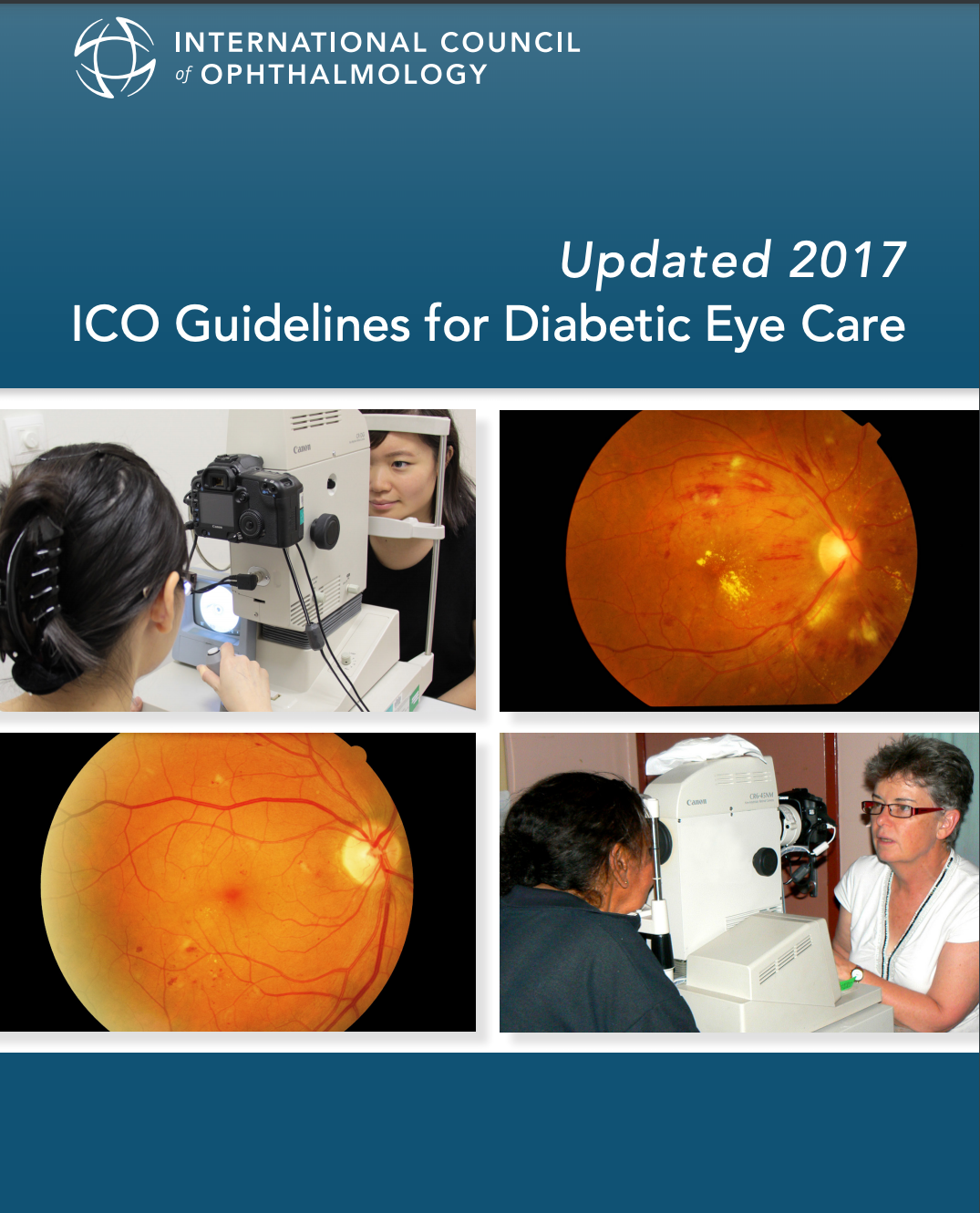
ICO Guidelines for Diabetic Eye Care
Last updated: September 2026
The International Council of Ophthalmology (ICO) Guidelines for Diabetic Eye Care are designed specifically to work across different resource settings — a practical strength for a country like India where access to retinal specialists varies enormously between urban and rural areas.
Screening intervals (key numbers to know)
| Diabetic retinopathy status | Recommended follow-up |
|---|---|
| No DR | Not routinely referred to ophthalmologist; screening per local program interval |
| Mild NPDR | Every 1-2 years (low/intermediate-resource settings); not routinely referred to ophthalmologist |
| Moderate NPDR | Every 6-12 months |
| Severe NPDR / PDR / center-involved DME | Referral to ophthalmologist and closer, individualized follow-up — the ICO guidelines set a slightly more intensive schedule for center-involved DME than ADA recommendations, specifically to reduce progression risk |
Initial screening timing
- Type 1 diabetes: initial dilated eye exam within 3-5 years of diagnosis, after age 10, then annual follow-up
- Type 2 diabetes: initial dilated eye exam shortly after diagnosis (retinopathy may already be present at diagnosis, unlike Type 1), then annual follow-up
Why resource-setting-specific guidelines matter
The scale of the problem driving these guidelines is substantial: an estimated 1 in 3 people with diabetes has some degree of diabetic retinopathy, and 20-30 million globally have sight-threatening PDR or DME. Crucially, the global prevalence of diabetic retinopathy has been declining with better diabetes control since 1980 — yet the absolute burden of vision loss from DR has still risen since 1990, driven by the sheer growth in type 2 diabetes cases, disproportionately in low- and middle-income countries. This is precisely why the ICO built resource-tiered recommendations rather than a single one-size-fits-all protocol — a fixed high-resource schedule is not achievable or sustainable in many screening programs.
Emerging tools referenced in current guidance
- Ultra-widefield imaging and handheld fundus cameras for community-level screening
- Teleophthalmology for remote grading, extending specialist reach into low-resource areas
- AI-based automated detection algorithms — increasingly validated for triaging referable disease in large screening programs
Key reference: Wong TY, et al. Guidelines on Diabetic Eye Care: The International Council of Ophthalmology Recommendations for Screening, Follow-up, Referral, and Treatment Based on Resource Settings. Ophthalmology. 2018;125(10):1608-1622.
📘 Want the exam-ready deep dive? This topic, and much more is covered in Ophthalmology Explorer (A High-Yield Clinical Reference for Ophthalmology Residents, Fellows & Board Exams) — available on Kindle. See all my books.
Experiencing symptoms like these? Learn about our Eye Department or book a consultation with Dr. Dhaval Patel.