Eponymous Signs in Ophthalmology
Last updated: September 2026
Eponymous signs are a favorite in viva/oral exams precisely because so many share names with figures from other specialties, or with each other — Marcus Gunn alone lends his name to three genuinely distinct entities. This is a working reference, not exhaustive, organized by name.
Marcus Gunn — one name, three entities (don't confuse them)
| Entity | What it is |
|---|---|
| Marcus Gunn pupil | The relative afferent pupillary defect (RAPD) — the swinging flashlight test shows paradoxical dilation of the affected pupil, indicating asymmetric optic nerve/retinal disease |
| Marcus Gunn jaw-winking syndrome | Congenital ptosis with synkinetic elevation of the ptotic lid on jaw movement, from an aberrant trigeminal-to-levator connection |
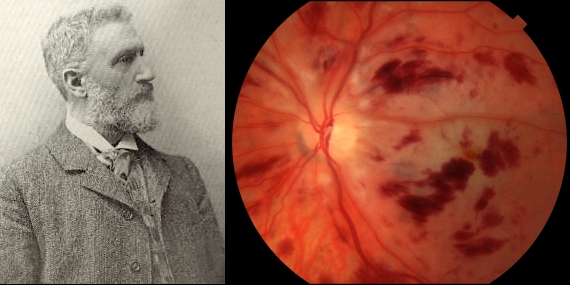
| Marcus Gunn dots/sign | Fundoscopic findings he described in his pioneering work on retinal vascular disease and hypertensive retinopathy |
Robert Marcus Gunn (1850-1909), a Scottish ophthalmologist, trained under Douglas Argyll Robertson and was instrumental in establishing systematic ophthalmoscopy teaching at Moorfields.
Hutchinson — four distinct eponyms
- Hutchinson's pupil: a dilated, light-unreactive pupil on the side of an intracranial mass lesion, from oculomotor nerve compression
- Hutchinson's triad: interstitial keratitis + eighth nerve deafness + Hutchinson's teeth (notched, peg-shaped incisors) — congenital syphilis
- Hutchinson's sign: vesicular skin lesions at the tip/side/root of the nose in herpes zoster ophthalmicus — a strong predictor of ocular involvement, since it indicates nasociliary nerve branch involvement (the same branch supplying the globe)
- Hutchinson's patch: also called the salmon patch — an ill-defined orangish-pink peripheral corneal area
Other high-yield eponymous signs
| Sign | Finding | Association |
|---|---|---|
| Amsler sign (Amsler-Verrey sign) | — | Fuchs heterochromic uveitis |
| Becker's sign | Visible pulsation of retinal arteries | Thyrotoxicosis |
| Argyll Robertson pupil | Accommodates but does not react to light (light-near dissociation) | Neurosyphilis — see our riddle on this exact sign |
| Collier's sign | Bilateral eyelid retraction | Dorsal midbrain (Parinaud) syndrome |
| Riddoch phenomenon | Preserved perception of moving targets despite apparent complete hemianopia | Occipital cortex lesions — see our Visual Field Defect Localization page |
A note on exam strategy
When an examiner asks about an eponym you don't recognize, the highest-yield guess is often a pupillary or eyelid sign, since these two categories account for a disproportionate share of ophthalmic eponyms — and always ask yourself whether the same name might correspond to more than one distinct entity, as with Marcus Gunn and Hutchinson above.
Key references: A to Z Eponyms in Ophthalmology, eOphtha. | List of eponymous medical signs, various sources. | Robert Marcus Gunn: The mind behind the eye. Indian J Ophthalmol.
📘 Want the exam-ready deep dive? This topic, and much more is covered in Ophthalmology Explorer (A High-Yield Clinical Reference for Ophthalmology Residents, Fellows & Board Exams) — available on Kindle. See all my books.
Want to know more about treatment? Read about Corneal Topography at Sadbhaav or book a consultation with Dr. Dhaval Patel.