Formulas in Ophthalmology
Last updated: September 2026
A handful of formulas come up repeatedly across ophthalmology exams and clinical practice — most residents encounter them piecemeal across different rotations, so here they are collected in one place.
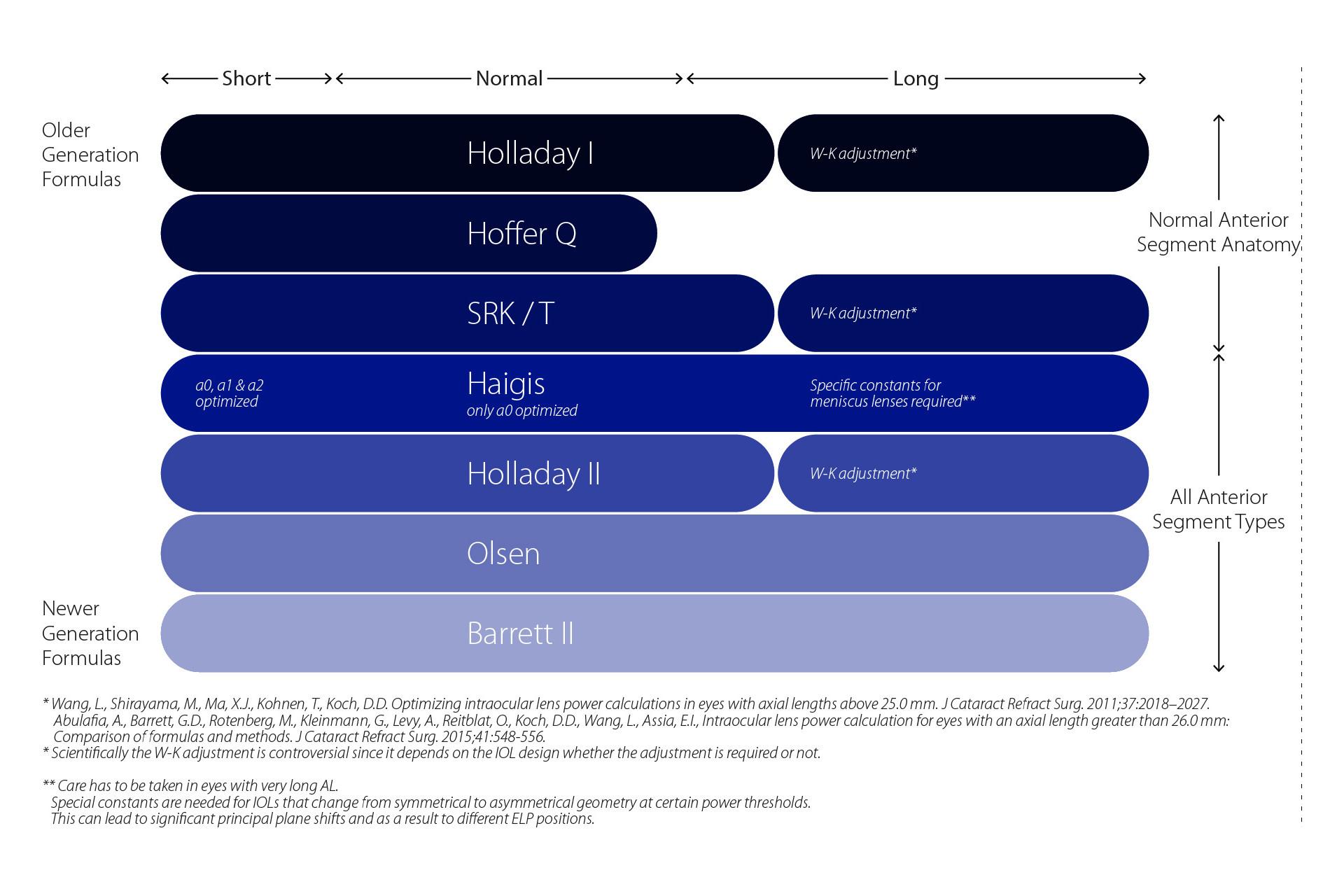
IOL power calculation: the SRK family
The original SRK ("Sanders-Retzlaff-Kraff") formula, published in 1980, was one of the first widely successful regression-based IOL power formulas:
P = A − 2.5L − 0.9K
- P = IOL power for emmetropia
- A = the "A-constant" — a lens/technique-specific offset constant, ideally personalized to the individual surgeon's technique
- L = axial length (mm)
- K = average keratometry (D)
SRK II added a correction factor F to the A-constant to fix SRK's known weakness (underestimating power in short eyes, overestimating in long eyes): +3D if AL<20mm, +2D for 20-20.9mm, +1D for 21-21.9mm, 0D for 22-22.5mm, and −0.5D for AL>24.5mm. SRK/T (1990) replaced the pure regression approach with a theoretical optics-based calculation of IOL position, and modern formulas (Barrett Universal II, Kane, EVO, Hill-RBF) have since surpassed all SRK variants in accuracy — see our IOL Calculators page for the current formula landscape.
Electro-oculography: the Arden ratio
Arden ratio = (Light peak / Dark trough) × 100
≥185 is normal, 150-184 is subnormal, <125 is flat/significantly abnormal — see our Electro-Oculography page for the full clinical context, including why a normal ERG with an abnormal EOG points specifically to Best disease.
Vertex distance conversion
When a spectacle correction is measured at one vertex distance but needs converting to another (e.g., converting a high-power spectacle prescription to a contact lens power):
F₂ = F₁ / (1 − d · F₁)
Where F₁ is the original power (in diopters), F₂ is the power at the new vertex distance, and d is the change in vertex distance (in meters). This matters most for higher-power corrections (roughly ±4D or greater), where vertex distance changes meaningfully affect the effective power.
Prentice's rule (prism calculation)
Prism (Δ) = Decentration (cm) × Lens power (D)
Used to calculate unwanted prismatic effect from optical decentration in spectacle lenses — genuinely useful for troubleshooting patient complaints of diplopia or asthenopia after a new spectacle prescription, when the decentration wasn't intentional.
AC/A ratio
AC/A = IPD (cm) + [(near deviation − distance deviation) / dioptric near stimulus] (heterophoria method)
Normal is roughly 3-5 prism diopters of convergence per diopter of accommodation — central to diagnosing and managing accommodative esotropia and convergence excess/insufficiency.
Snellen fraction to logMAR conversion
logMAR = log₁₀(denominator/numerator of Snellen fraction)
E.g., 20/40 vision = log₁₀(40/20) = log₁₀(2) = 0.3 logMAR. Each line on a standard logMAR chart represents a 0.1 logMAR change — this standardized, equal-interval scale is why logMAR (not Snellen) is used for research reporting and precise serial comparison of visual acuity.
Key references: SRK/T Formula: A Review. CRST Europe. 2012. | The seeds that grew into SRK, a complete history. 2024.
📘 Want the exam-ready deep dive? This topic is covered in iNotes 2027: Basic Science & Optics (Ophthalmology Postgraduate Exam Notes) — available on Kindle. See all my books.
Want to know more about treatment? Read about Corneal Topography at Sadbhaav or book a consultation with Dr. Dhaval Patel.