Instruments in Ophthalmology: Who Invented What
Last updated: September 2026
Behind every instrument on your exam tray is a specific inventor and a specific problem they were trying to solve — knowing the story makes the instrument's design logic (and its limitations) much easier to remember.
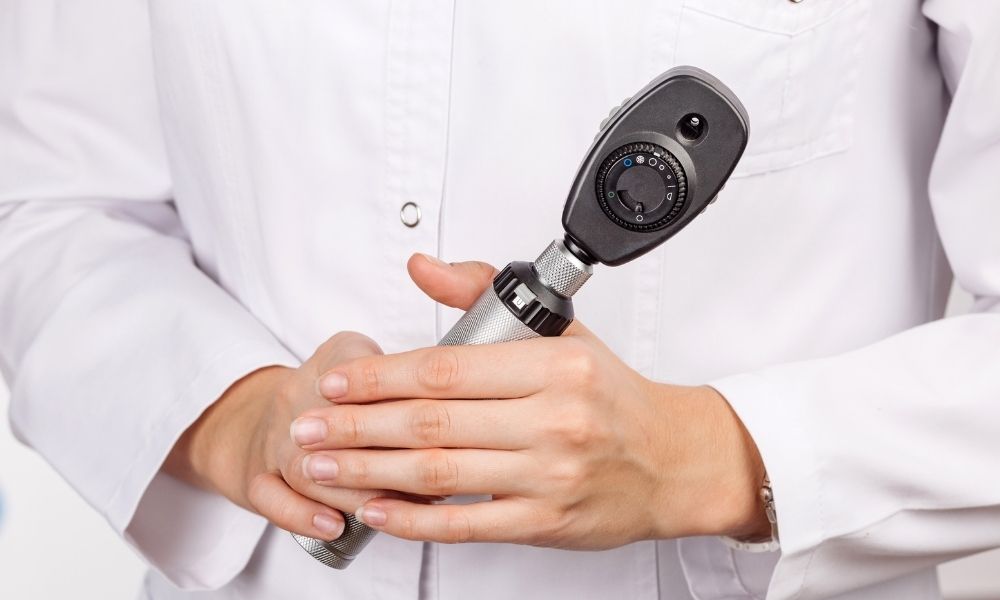
The ophthalmoscope
- Hermann von Helmholtz (1850) is credited with introducing the first practical ophthalmoscope (his Augenspiegel, or "eye mirror") — built from cardboard, glue, and microscope glass while he was a 29-year-old physiology professor trying to demonstrate to students why the pupil sometimes appears black and sometimes doesn't
- He wasn't actually first: Johannes Purkinje had glimpsed the retina in 1823, and Charles Babbage (better known for early computing) built a similar device in 1847 — but neither publicized their work, so Helmholtz's 1850 publication is what changed ophthalmology
- By 1900, over 200 ophthalmoscope variants existed worldwide, reflecting rapid iteration once the core idea took hold
- Christian Georg Theodor Ruete (1852) popularized the indirect method of ophthalmoscopy — Helmholtz had anticipated it, but Ruete made it practical
The slit lamp
- Allvar Gullstrand (1911) — a Swedish ophthalmologist and Nobel laureate for his work on the optics of the eye — is credited with the first slit lamp concept, his "large reflection-free ophthalmoscope," manufactured by Zeiss
- Hans Goldmann (1937) — presented the slit lamp design that first allowed examination of the entire eye, from cornea to fundus, on a seated patient with one-handed three-dimensional control. The Haag-Streit 900, based on Goldmann's 1958 vertical-illumination refinement, remains the design standard today with only minor modifications
Tonometry
- Hans Goldmann (1954) — introduced applanation tonometry, mounted directly on his slit lamp design — still the international reference standard against which all other IOP measurement methods are compared
- Goldmann was remarkably prolific for a single ophthalmologist: beyond the slit lamp and applanation tonometer, he also developed the Goldmann perimeter (1945, the cupola perimeter that standardized background/target illumination for visual field testing) and a colorimeter
Perimetry
- Hans Goldmann (1945): the Goldmann cupola perimeter — kinetic perimetry with standardized illumination
- Franz Fankhauser (1974): Goldmann's former assistant, developed the first automated static perimeter — the direct ancestor of the modern Humphrey field analyzer's threshold-testing approach
Why this history matters practically
Notice how concentrated ophthalmic instrument innovation was around a small number of individuals (Helmholtz, Gullstrand, Goldmann) working in German-speaking Europe in the late 19th and 20th centuries — useful context for understanding why so many foundational instrument names cluster together, and a common thread examiners like to probe ("who else did this person's work influence?").
Key references: History of the Ophthalmoscope, LITFL Eponymictionary. | Gloor B. Hans Goldmann: the man who coined the daily practice of ophthalmology. Acta Ophthalmol. 2009. | Helmholtz, Hermann von, AAO Biographies.
📘 Want the exam-ready deep dive? This topic is covered in iNotes 2027: Basic Science & Optics (Ophthalmology Postgraduate Exam Notes) — available on Kindle. See all my books.
Want to know more about treatment? Read about Corneal Topography at Sadbhaav or book a consultation with Dr. Dhaval Patel.