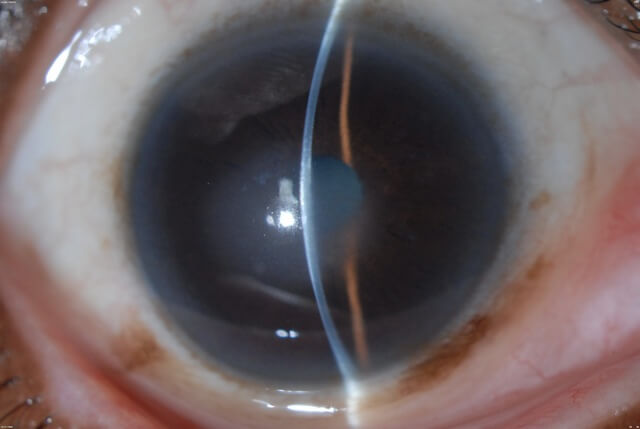
Fuchs Endothelial Corneal Dystrophy
Last updated: September 2026
Fuchs endothelial corneal dystrophy (FECD) is common — affecting 4-7% of people over 40 in the US — and it accounts for roughly a third of all corneal transplants performed today. The surgical approach has changed dramatically over the past two decades, and there's now a genuinely new option that avoids transplantation altogether in select patients.
Pathophysiology and presentation
- Progressive dysfunction of the corneal endothelium: pleomorphism and polymegethism of endothelial cells, with accumulation of excrescences (guttae) on Descemet's membrane
- As endothelial cell density falls below the threshold needed to keep the cornea deturgesced, stromal and eventually epithelial edema develops
- Classic symptom: blurry vision worse on waking, improving through the day as surface tear evaporation partially compensates for overnight corneal swelling (since the closed eyelid prevents evaporative dehydration of the cornea during sleep)
- Two forms: early-onset (first decade, equal sex distribution, rare) and the much more common late-onset form (presents 4th decade or later, female:male ratio roughly 3:1), both progressing to end-stage disease over 2-3 decades
Current surgical standard: endothelial keratoplasty has replaced PK
Full-thickness penetrating keratoplasty (PK) was the historical mainstay but has been substantially replaced by selective endothelial replacement, which only removes and replaces the dysfunctional layer:
| Procedure | Graft composition | Notes |
|---|---|---|
| DSEK/DSAEK | Donor stroma + Descemet's membrane + endothelium | Easier to prepare and handle than DMEK; hyperopic shift and graft folds are recognized drawbacks |
| DMEK | Descemet's membrane + endothelium only (no stroma) | Current gold standard — superior visual outcomes, faster visual rehabilitation, and lower rejection risk (requiring less long-term steroid) compared to DSEK and PK |
A genuinely current option: DWEK/DSO (no donor tissue needed)
Descemetorhexis without endothelial keratoplasty (DWEK), also called Descemet stripping only (DSO), is an emerging technique for carefully selected patients:
- Candidates: symptomatic central guttae or edema with clear peripheral cornea, and an endothelial cell count of at least 1,000 cells/mm² in the peripheral, unaffected cornea
- The central abnormal Descemet's membrane/endothelium is simply stripped away, relying on migration and proliferation of healthy peripheral endothelial cells to reclear the central cornea — no donor tissue is transplanted at all
- Reported clearance rates range widely (63-100%) depending on patient selection; topical ripasudil, a ROCK (Rho-associated kinase) inhibitor, may improve endothelial proliferation and corneal clearance, and is an active area of combined use with DSO
- Advantages: eliminates graft-related complications, rejection risk, and the need for long-term postoperative corticosteroids entirely
- A 2023-2024 UK national survey found strong surgeon interest in learning DWEK (97% of respondents), though actual practice experience remains limited — this is a technique still gaining adoption, not yet mainstream
- Important safety net: DSO can be rescued with a standard DMEK if the cornea fails to clear on its own — so attempting DSO first doesn't foreclose the conventional option
Practical takeaway
DMEK remains the default, evidence-backed standard for symptomatic FECD. DSO/DWEK with ROCK inhibitor support is a genuinely emerging alternative worth knowing about for the right patient (adequate peripheral endothelial reserve), even though it isn't yet universal practice.
Key references: Evaluation and Management of Fuchs Dystrophy, AAO EyeNet. | Fuchs Endothelial Corneal Dystrophy: An Updated Review. 2024. | Surgeon Perspectives on DWEK for FECD: A UK National Survey. 2024.
📘 Want the exam-ready deep dive? This topic is covered in iNotes 2027: Cornea and Refractive (Ophthalmology Postgraduate Exam Notes) — available on Kindle. See all my books.
Want to know more about treatment? Read about Corneal Topography at Sadbhaav or book a consultation with Dr. Dhaval Patel.