Online IOL Calculator Tools
Last updated: September 2026
IOL power calculation has moved well beyond the classic regression and theoretical formulas — modern data-driven and AI-assisted formulas now consistently outperform older methods, especially in eyes that don't fit the "average" biometric profile.
Modern formula accuracy: what the evidence shows
Comparative studies consistently rank newer-generation formulas — Barrett Universal II, Kane, EVO (now EVO 2.0), and Hill-RBF (now 3.0) — above older formulas like SRK/T, Hoffer Q, and Holladay 1 for most eyes, with the gap widening in eyes with unusual axial length:
| Eye type | Best-performing formulas (current evidence) |
|---|---|
| Average axial length | Barrett Universal II, Kane, EVO — largely comparable, all outperform SRK/T |
| Long/myopic eyes (AL ≥26mm) | Kane and Hill-RBF show significantly lower mean absolute error than SRK/T; Barrett Universal II also performs well |
| Extreme axial myopia (AL ≥30-32mm) | Kane and Hill-RBF show the lowest error rates; SRK/T is least reliable at this range |
| Short/hyperopic eyes | Barrett Universal II, Kane, and VRF-G formulas outperform older short-eye-specific formulas like Hoffer Q |
| Post-refractive surgery eyes | EVO 2.0, Barrett True-K, Pearl DGS, and Hoffer QST — particularly when combined with total/posterior keratometry — are the current preferred choices |
A useful practical habit: run more than one modern formula and compare. When formulas agree closely, confidence in the predicted power is higher; when they diverge, it flags an eye that deserves extra caution (and a conversation with the patient about a wider possible refractive outcome range).
Online calculators
IOL calculator ASCRS Simple Online Calculator (includes Barrett Universal II, Kane, and other modern formulas in one interface).
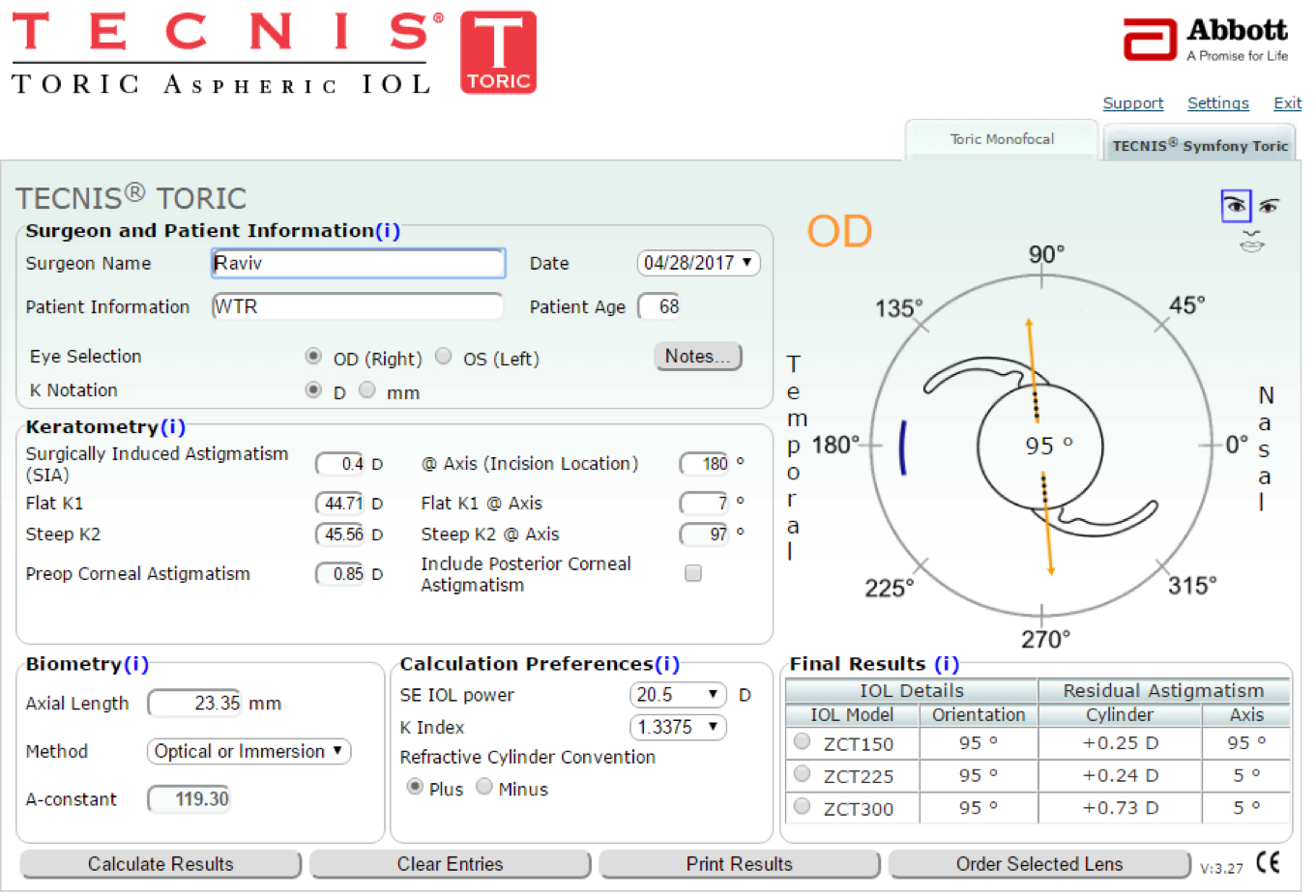
Toric IOL calculators
Toric lens calculations require accounting for corneal astigmatism, surgically-induced astigmatism (SIA), and effective lens position — get any of these wrong and the resulting residual astigmatism can undo much of the benefit of using a toric lens in the first place.
📐 Recommended: Barrett Toric Calculator (hosted on ASCRS.org) — widely regarded as one of the most accurate toric calculators available, since it accounts for posterior corneal astigmatism and predicted lens position rather than treating every eye as "average." It's brand-agnostic, so it works whether you're implanting a Tecnis, Alcon, Zeiss, Rayner, or any other toric lens — calculate the required cylinder power and axis here, then cross-check against your specific lens manufacturer's available toricity options.
Most individual lens manufacturers (Alcon, Tecnis/Johnson & Johnson, Zeiss, Rayner, Bausch + Lomb) also offer their own toric calculators, but these are typically only accessible after creating a free surgeon account directly on the manufacturer's own site, since they're tied to that company's specific lens ordering system. If you already use a particular brand, it's worth setting up an account with them directly rather than searching for a public link, since these tools aren't generally open-access.
Also worth knowing: a postoperative toric lens rotation calculator (searchable via the ASCRS site above) is useful when a toric IOL appears rotated after surgery — it helps determine whether repositioning is likely to improve the refractive outcome enough to justify a second procedure.
Key references: Moshirfar M, et al. Comparing the accuracy of Kane, Barrett Universal II, Hill-RBF, EVO, and Ladas Super Formula. Clin Ophthalmol. 2023. | Compilation of IOL Power Calculation Formulas and When to Utilize, EyeWiki. | Review of Ophthalmology, IOL Calculation for Unusual Eyes, 2024.
📘 Want the exam-ready deep dive? This topic is covered in iNotes 2027: Lens (Ophthalmology Postgraduate Exam Notes) — available on Kindle. See all my books.
Want to know more about treatment? Read about Cataract Surgery at Sadbhaav or book a consultation with Dr. Dhaval Patel.