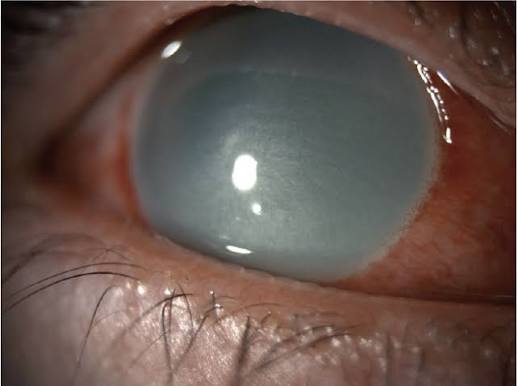
Chemical Eye Injury: Roper-Hall vs Dua Grading
Last updated: September 2026
Chemical eye injuries are graded to predict prognosis and guide treatment intensity — but the original 1965 scale has a genuine limitation that a newer classification specifically fixed, and residents should know both systems since neither has fully replaced the other in practice.
First principles: alkali vs. acid
Alkali burns (e.g., lime, ammonia, lye) are generally more destructive than acid burns — alkali causes saponification of cell membrane fatty acids and continues penetrating deeper tissue over time, whereas most acids (except hydrofluoric acid) cause protein coagulation that tends to limit their own further penetration.
Roper-Hall classification (1965) — the original standard
| Grade | Cornea | Limbal ischemia | Prognosis |
|---|---|---|---|
| I | Corneal epithelial damage only | None | Excellent |
| II | Hazy cornea, iris details visible | <1/3 | Good |
| III | Total epithelial loss, stromal haze obscuring iris details | 1/3 to 1/2 | Guarded |
| IV | Opaque cornea, iris/pupil obscured | >1/2 | Poor |
The problem with Grade IV: in the original scale, all eyes with >50% limbal ischemia were lumped into a single "poor prognosis" category — but clinical experience showed this group actually contains eyes with very different real-world outcomes, some of which respond well to modern treatments like amniotic membrane transplantation.
Dua's classification (2001) — the refinement
Dua kept the same underlying logic but fixed the Grade IV problem by subdividing severe injury into Grades IV, V, and VI based on precise clock-hour limbal involvement and percentage of conjunctival involvement, using a flexible analog scale:
| Grade | Limbal involvement (clock hours) | Conjunctival involvement | Prognosis |
|---|---|---|---|
| I | 0 | 0% | Very good |
| II | ≤3 | ≤30% | Good |
| III | >3-6 | >30-50% | Good |
| IV | >6-9 | >50-75% | Good to guarded |
| V | >9-<12 | >75-<100% | Guarded to poor |
| VI | 12 (total) | 100% | Very poor |
A key conceptual shift: Dua's system uses limbal fluorescein staining (marking actual epithelial/stem cell loss) rather than relying purely on visible perilimbal blanching (ischemia) — since total limbal stem cell loss can occur even with deceptively modest-looking ischemia. Comparative studies have found Dua's grade has better prognostic predictive value than Roper-Hall in severe injuries specifically, which is why many cornea specialists now prefer it, particularly when significant limbal stem cell disease is suspected.
A genuinely current diagnostic advance: objective ischemia measurement
Both classifications have historically relied on subjective clinical estimation of "how much" limbus looks ischemic — a real source of inter-observer variability. Anterior segment OCT angiography (AS-OCTA) now allows objective, quantitative visualization of limbal vasculature, directly measuring the absence of perfusion in clock-hour terms rather than estimating it by eye. This is an active area of validation but represents a meaningful step toward removing subjectivity from what has always been a fundamentally visual, examiner-dependent grading process.
Immediate management principle (regardless of grading system used)
- Copious irrigation is the immediate priority — before formal grading, before checking visual acuity, before anything else. Continue until pH normalizes, checked with litmus paper in the fornices
- Double-evert the eyelids to sweep out any retained solid particulate matter (common with lime/cement injuries) that would otherwise continue releasing alkali
- Only after irrigation and stabilization does formal grading (Roper-Hall or Dua) guide the subsequent treatment intensity and prognosis discussion
Key references: Dua HS, King AJ, Joseph A. A new classification of ocular surface burns. Br J Ophthalmol. 2001. | Precision of limbal ischemia evaluation with AS-OCTA. 2024. | Management Strategies of Ocular Chemical Burns: Current Perspectives. Clin Ophthalmol. 2020.
📘 Want the exam-ready deep dive? This topic, and much more is covered in Ophthalmology Explorer (A High-Yield Clinical Reference for Ophthalmology Residents, Fellows & Board Exams) — available on Kindle. See all my books.
Want to know more about treatment? Read about Corneal Topography at Sadbhaav or book a consultation with Dr. Dhaval Patel.