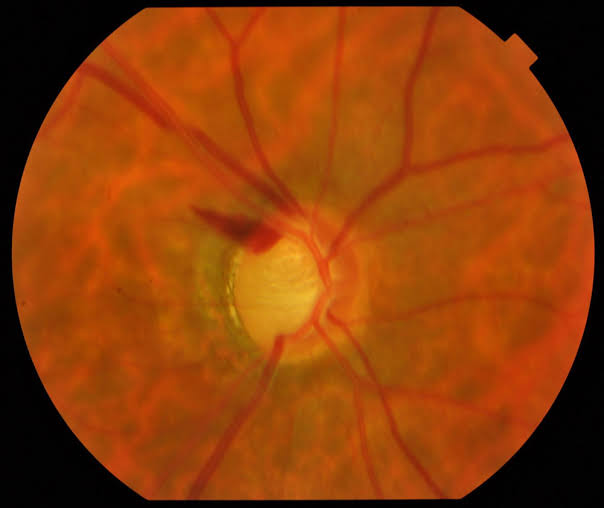
Normal-Tension Glaucoma: Diagnosis and the CNTGS Debate
Last updated: September 2026
Normal-tension glaucoma (NTG) — glaucomatous optic neuropathy with IOP consistently in the statistically normal range — has always been a diagnosis that challenges the simple "high pressure causes glaucoma" model. A genuinely striking 2025-2026 reassessment now questions whether the foundational trial evidence for treating it is as solid as it's always been taught to be.
Diagnosis: exclude the mimics first
NTG can masquerade as, or be masked by, other optic neuropathies — a careful workup matters before settling on the diagnosis:
- Look for clues suggesting a non-glaucomatous cause: bilateral pre-chiasmal field defects that don't respect the pattern expected for glaucoma, disc pallor out of proportion to cupping (glaucoma typically causes cupping with relatively preserved neuroretinal rim color until late stages)
- Consider a targeted workup in atypical presentations: MRI (to exclude a compressive lesion), and depending on the clinical picture, an antinuclear antibody panel, syphilis serology, vitamin B12/B9 levels, and even a heavy metal panel in appropriate contexts
- Supporting clinical features: peripapillary atrophy, splinter (disc margin) hemorrhages, and systemic vascular dysregulation (migraine with aura, cold extremities, low blood pressure) — the vascular dysregulation association is a genuine, if incompletely understood, part of NTG's proposed pathophysiology
- Neurological evaluation and imaging are reserved for atypical cases or those progressing unexpectedly, not needed routinely for every NTG diagnosis
The foundational trial: CNTGS
The Collaborative Normal-Tension Glaucoma Study has long been cited as establishing that a 30% IOP reduction slows NTG progression, with the treated group showing progression in only 12% of eyes vs. 35% in untreated eyes at 5 years — and the finding that 65% of untreated eyes showed no progression at all over 5 years, supporting a genuine "many NTG cases are non-progressive" clinical reality that still shapes practice today (observation is a legitimate initial strategy for many patients).
A genuinely important current re-examination
A 2025-2026 statistical reassessment of the CNTGS methodology raises real concerns about how solid this foundational conclusion actually is:
- The original CNTGS analysis shifted the treatment group's baseline to the point of IOP stabilization after treatment began — rather than to the actual time of randomization — which excluded early progression events in the treated group
- This methodological choice is now described as introducing "immortal time bias" — a well-recognized statistical pitfall where post-hoc reassignment of a starting point can artificially inflate an apparent treatment benefit
- When re-analyzed using a strict intention-to-treat approach (as originally randomized, without the post-hoc baseline shift), the treatment effect was not statistically significant
- The reassessment authors call for new, methodologically rigorous prospective trials to properly clarify IOP reduction's true role in NTG
Practical implication for residents: continue to know CNTGS as the classic, most-cited evidence for NTG treatment — but be aware that its methodology has recently come under serious, credible statistical scrutiny. This doesn't mean IOP-lowering treatment is wrong for progressive NTG (there's no better alternative and the biological rationale remains sound), but the certainty with which CNTGS is often presented in older teaching may be overstated.
Practical management approach
- Confirm genuine progression (serial OCT/visual fields, disc photos) before committing to treatment in mild, apparently stable cases — many patients don't need aggressive intervention
- Once progression is documented, target the same 30% IOP reduction from baseline that CNTGS popularized
- Selective laser trabeculoplasty is a reasonable first-line option in patients with IOP in the midteens or higher
- Brimonidine is sometimes favored for its theoretical neuroprotective properties, though this remains unproven in humans
- MIGS procedures show modest IOP reduction (roughly 2-3 mmHg) in NTG per recent meta-analysis data, useful as an adjunct though rarely sufficient alone for significant reduction
Key references: Reassessment of the CNTGS: Statistical Evidence and Implications for Current Management. Ophthalmol Ther. 2026. | Normal Tension Glaucoma, StatPearls (2024). | Managing Normal-Tension Glaucoma. Glaucoma Today. 2024.
📘 Want the exam-ready deep dive? This topic is covered in iNotes 2027: Glaucoma (Ophthalmology Postgraduate Exam Notes) — available on Kindle. See all my books.
Want to know more about treatment? Read about Corneal Topography at Sadbhaav or book a consultation with Dr. Dhaval Patel.