Pseudoexfoliation Syndrome and Glaucoma
Last updated: September 2026
Pseudoexfoliation (PXF) syndrome is deceptively easy to overlook — most patients are entirely asymptomatic — yet it's the most common identifiable cause of secondary open-angle glaucoma worldwide, and it turns routine cataract surgery into a meaningfully higher-risk procedure.
What it actually is
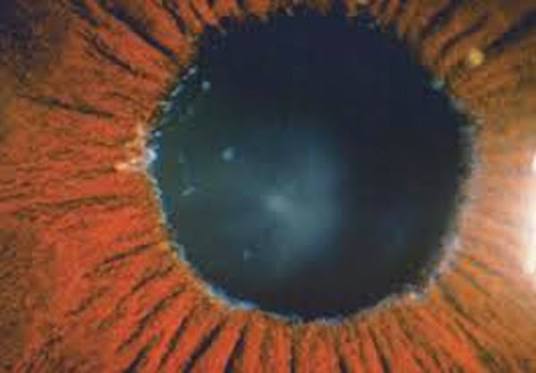
PXF is a systemic disorder of the extracellular matrix — abnormal, cross-linked fibrillar material accumulates progressively not just in the eye but in the heart, blood vessels, lungs, and meninges. In the eye, it deposits at the pupillary margin, on the lens surface, and throughout the anterior chamber drainage structures.
Genetics: LOXL1, with an important caveat
- LOXL1 (lysyl oxidase-like 1), a gene encoding a cross-linking enzyme central to elastic fiber formation, is the strongest known genetic risk factor identified so far
- Important nuance: the originally identified "risk" variants (R141L, G153D) show conflicting associations across different populations — in some studies, the "risk" allele frequency is actually similar or even higher in controls than in PXF patients, suggesting these specific variants may be markers linked to the true causal variant rather than causal themselves
- Newer research has identified additional variants (e.g., an exonic SNP with intragenic epistatic interactions) that may better explain the missing heritability
- Clinically important: most people carrying high-risk LOXL1 alleles never develop PXF at all — genetic risk alone has poor predictive value, reinforcing that PXF remains a clinical diagnosis by examination, not a genetic one
Glaucoma risk and disease behavior
- Roughly 40-50% of patients with PXF syndrome eventually develop pseudoexfoliation glaucoma
- PXF glaucoma behaves more aggressively than typical POAG: higher mean IOP, greater diurnal fluctuation, more frequent severe pressure spikes, faster visual field progression, and poorer response to medical therapy
- In the Early Manifest Glaucoma Trial, the presence of PXF was the single most important independent risk factor for glaucoma progression — a genuinely strong, well-established prognostic signal
- PXF carries an association with cardiovascular and cerebrovascular disease as part of its systemic extracellular matrix pathology — worth being aware of, even though it doesn't usually change ophthalmic management directly
Why cataract surgery is genuinely higher risk
PXF eyes dilate poorly and have weakened, unstable zonules from the same fibrillar deposition process affecting the lens capsule and zonular apparatus:
- 5-10 fold increase in surgical complication rates compared to non-PXF cataract surgery
- Higher risk of capsular bag rupture, zonular dialysis, vitreous loss, and dense nuclear cataracts requiring more phaco energy
- Late postoperative IOL subluxation/dislocation is a recognized long-term risk, sometimes occurring years after apparently uneventful surgery — worth mentioning specifically during informed consent
- Practical surgical adaptations: capsular tension rings, iris hooks/pupil expansion devices for poor dilation, and gentler phaco technique are commonly used to mitigate these risks
Practical takeaway
Actively look for PXF signs (peripupillary transillumination defects, flaky material on the anterior lens capsule, patchy trabecular meshwork pigmentation on gonioscopy) in every patient before cataract surgery, not just those with known glaucoma — since PXF is often asymptomatic and easy to miss on a cursory exam, and finding it changes both surgical planning and long-term glaucoma monitoring.
Key references: Pseudoexfoliation Syndrome and Glaucoma, StatPearls (2023). | Cataract Surgery in Pseudoexfoliation Syndrome, EyeWiki. | Genetics and Genomics of Pseudoexfoliation Syndrome/Glaucoma.
📘 Want the exam-ready deep dive? This topic is covered in iNotes 2027: Glaucoma (Ophthalmology Postgraduate Exam Notes) — available on Kindle. See all my books.
Want to know more about treatment? Read about Corneal Topography at Sadbhaav or book a consultation with Dr. Dhaval Patel.