LASIK vs ICL: Which Is Right for You?
Both LASIK and ICL (phakic intraocular lens) correct refractive errors and reduce dependence on glasses — but they work in fundamentally different ways, and the right choice depends on your specific eyes, not personal preference alone.
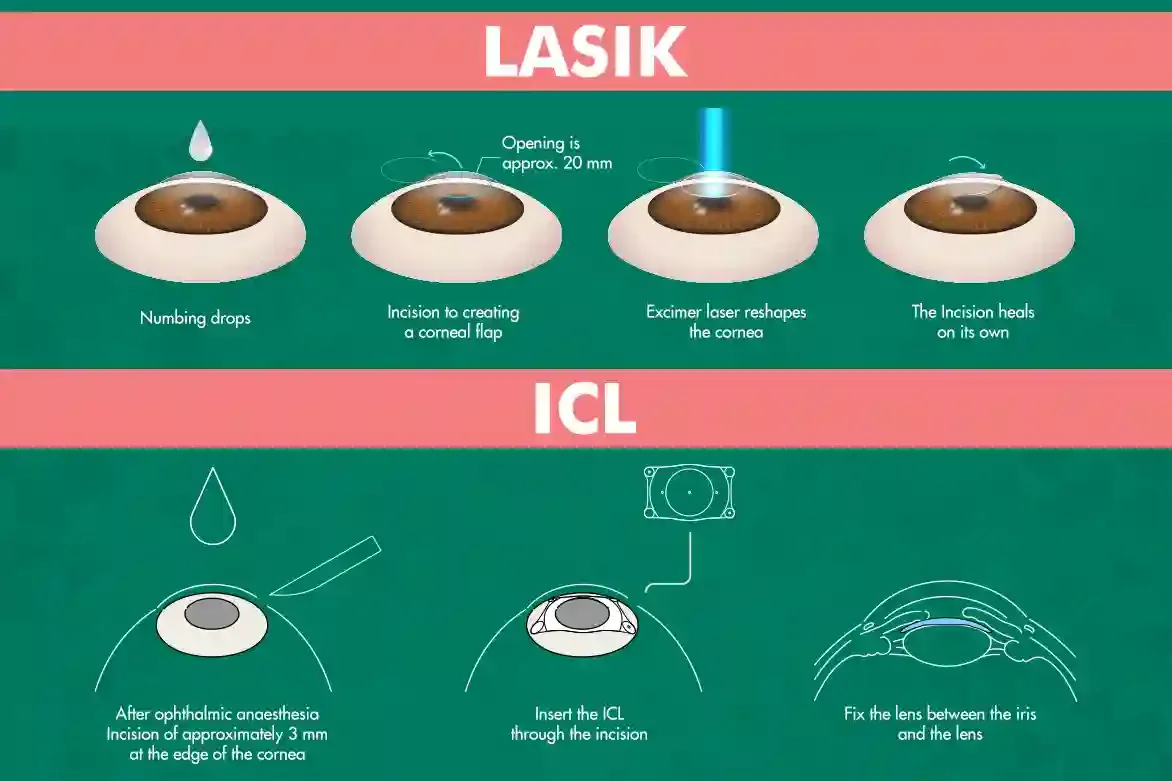
The core difference
LASIK reshapes the cornea itself using a laser, permanently changing its curvature to correct how light focuses on the retina. ICL takes a completely different approach: it leaves your natural cornea untouched and instead places a small, biocompatible lens inside the eye, in front of your natural lens, to correct vision. Nothing about your eye's existing structure is reshaped or removed.
Who tends to suit LASIK
LASIK generally suits patients with standard-range prescriptions, healthy and adequately thick corneas, and stable vision for at least a year. It's a quicker, less invasive procedure since nothing is placed inside the eye — just chair-side, using numbing drops, and vision often improves within a day.
Who tends to suit ICL
ICL is usually the better option for patients with high prescriptions (especially high myopia), thinner corneas, or other factors that rule out LASIK entirely. Because it doesn't depend on how much corneal tissue is available to reshape, it can correct degrees of refractive error that LASIK sometimes can't safely address.
Reversibility — a genuinely important difference
This is one of the most meaningful practical differences between the two. LASIK reshapes the cornea permanently — it isn't reversible. ICL is different: since the lens is simply placed inside the eye rather than reshaping tissue, it can be removed or exchanged later if ever needed. This doesn't make ICL automatically the "safer" choice, since it is an intraocular procedure with its own distinct risks, but it is a real, practical distinction worth understanding.
Comparing All Vision Correction Options
Beyond LASIK and ICL, a few other procedures are worth understanding — SMILE, LASEK, and PRK are all corneal laser techniques, each with different trade-offs in recovery time and corneal impact. Here's an honest, side-by-side comparison of the options we discuss with patients:
| Procedure | How It Works | Typical Recovery | Best Suited For |
|---|---|---|---|
| LASIK | A thin corneal flap is created and lifted, the laser reshapes tissue underneath, and the flap is repositioned | 1–2 days | Standard prescriptions with healthy, adequately thick corneas |
| SMILE | A small lens-shaped piece of tissue (lenticule) is created inside the cornea using a laser and removed through a tiny incision — no flap | 1–2 days | Nearsightedness with or without astigmatism; patients wanting a flapless option |
| LASEK | The cornea's thin outer layer (epithelium) is gently loosened and repositioned after laser reshaping, rather than cutting a deeper flap | 5–7 days | Thinner corneas, or patients at higher risk of eye trauma who need a more impact-resistant result |
| PRK | The corneal surface layer is removed (not repositioned) before laser reshaping, and regrows naturally over the following days | 1–3 weeks | Thin or irregular corneas where LASIK isn't suitable |
| ICL | A lens is implanted inside the eye without reshaping or removing any corneal tissue | 1–2 days | High myopia, thin corneas, or other factors ruling out corneal laser surgery entirely |
Two honest notes worth knowing: LASIK and SMILE offer the fastest recovery and least discomfort for most patients, while LASEK and PRK — though slower to heal — are genuinely safer choices for thinner or more irregular corneas. And ICL remains the only option here that's reversible, since nothing about the cornea itself is permanently altered.
Neither is simply "better"
Research comparing outcomes between LASIK and phakic lens procedures generally shows both are safe and effective for the right candidate — the real question isn't which procedure is superior, it's which one your specific eyes are actually suited for. A thorough evaluation, including corneal thickness, corneal shape (topography), and your full prescription history, is what actually determines this, not preference alone.
How Dr. Patel helps you decide
Dr. Dhaval Patel, MD (Ophthalmology, AIIMS New Delhi), evaluates your eyes thoroughly before recommending any of these options, and will tell you honestly if you're not a good candidate for one or the other rather than steering you toward whichever procedure is more convenient to offer. Read more about Dr. Patel's credentials and experience.
Not sure which option fits your eyes? Book a consultation or message us on WhatsApp — a proper evaluation is the only way to know for certain.