Cataract Surgery Packages
Straightforward, upfront pricing for cataract surgery at Sadbhaav — because deciding on the right lens shouldn't mean guessing at cost. These are our current package rates by intraocular lens (IOL) type; see our full IOL Lens Types Guide if you're unsure which category fits your needs.
Travelling from outside India? Send your reports for a free review and cost estimate: see International Patients.
| Package | What the lens does | Glasses after surgery | Total package cost (per eye) |
|---|---|---|---|
| Monofocal Spheric | Clear distance vision at one fixed focus. The longest track record and the most economical choice. | Reading glasses needed; light distance glasses sometimes | ₹35,000 |
| Monofocal Aspheric | Distance vision with better contrast, especially at night and in dim light | Reading glasses needed | ₹40,000 |
| Monofocal Aspheric (Yellow) | As above, with a yellow (blue-light filtering) tint | Reading glasses needed | ₹45,000 |
| Enhanced Monofocal | Distance vision plus a useful extra range for intermediate tasks (computer, dashboard, cooking), with night vision similar to a monofocal | Reading glasses for fine print | ₹60,000 |
| Enhanced Monofocal (Yellow) | As above, with a yellow (blue-light filtering) tint | Reading glasses for fine print | ₹60,000 |
| Toric, EDOF, multifocal and trifocal lenses | Correct astigmatism (toric) or give a wider range of focus (EDOF, multifocal, trifocal) | Fewer or no glasses for most tasks, depending on the lens | Quoted after biometry and consultation, because the right lens and brand depend on your eye measurements |
Rates last updated August 2026. Current rates may differ — please confirm with your ophthalmologist at the time of consultation.
A note on comparing prices: please don't compare these rates directly against other clinics or hospitals. Package pricing varies significantly based on the specific lens brand, hospital overhead, surgeon experience, and what's included (pre-op tests, post-op visits, medication). These figures are meant to give you a genuine, honest starting point for cataract surgery costs at Sadbhaav — not a like-for-like comparison tool across providers.
"Starting from ₹10,000" versus a total package: how to read cost adverts
Many hospital websites show a low "starting from" price. That figure is usually for the most basic option: often small-incision surgery (SICS) or the cheapest lens, for one eye, and sometimes without the tests, medicines, day-care charges or follow-up visits. When the lens is upgraded or these items are added, the final bill can be two or three times the headline number.
The prices on this page are total package prices per eye for each lens category, so the number you see is the number you plan for. If your eye needs something extra (see below), we tell you before surgery, not after.
Ten questions to ask any hospital before you compare
Use this checklist with any hospital, including ours. Two quotes are only comparable when the answers match.
- Is the price for one eye or both eyes?
- Which operation is it: phaco, micro-incision phaco (MICS), small-incision surgery (SICS) or laser-assisted (FLACS)? The table below explains the difference.
- Which lens exactly? Ask for the brand and model, the material (hydrophobic or hydrophilic acrylic; hydrophobic lenses are less likely to cause later clouding of the capsule), and whether it is foldable (goes in through a tiny cut) or rigid (needs a larger cut).
- Are the tests before surgery included: eye measurements for lens power (biometry and keratometry), retina check and blood tests?
- Are the day-care charges, operation theatre and anaesthesia included?
- Are eye drops and medicines after surgery included?
- How many follow-up visits are included, and for how long?
- Who will actually operate: the senior surgeon you met, or someone else?
- What happens, and what does it cost, if there is a complication or a second procedure is needed?
- Does insurance or cashless cover the full amount, or will there be a co-payment or lens sub-limit?
What's typically included
- Check-up before surgery: your vision, the length of your eye and the curve of your cornea (used to calculate the lens power), a retina check and your eye pressure
- The operation itself: stitch-free phaco surgery (phacoemulsification), usually 20 to 40 minutes, as a day-care procedure, so you go home the same day
- The intraocular lens matching your chosen package
- Immediate post-operative care and initial follow-up
Every patient has a few basic checks before surgery: blood sugar (fasting and after a meal), blood pressure, and blood tests for HIV and hepatitis B (HBsAg). Please tell your doctor about any other illness and every medicine you take, especially blood thinners and diabetes medicines, because this can change both the surgical plan and the lens power calculation.
What may need a separate charge
Most patients need only the package. A few eyes need more, and it is fair to know about this in advance:
- Extra tests when your eye needs them, such as an OCT scan of the macula (diabetes, macular disease), a specular microscopy count of the corneal cells, or a B-scan ultrasound when the cataract is too dense to see the retina.
- Treatment of other eye problems found during the work-up, such as diabetic retinopathy, glaucoma or eyelid infection, which may need treatment before surgery.
- New spectacles about a month after surgery.
- YAG laser, if a "secondary cataract" (posterior capsule opacification) forms months or years later. This is a quick laser in the clinic, not a repeat operation. Read YAG laser capsulotomy.
- A check-up by a physician (fitness for surgery) if you have heart or lung disease, or sugar or blood pressure that is not under control.
Why two people can pay different amounts
| Factor | Why it changes the cost |
|---|---|
| Lens category and brand | The largest single factor. Within the same category, lenses from different manufacturers differ in material, optics and price. |
| Astigmatism | Significant corneal astigmatism is best corrected with a toric lens, which costs more than a standard lens. |
| How complex the eye is | A very hard (mature) cataract, a pupil that does not dilate well, pseudoexfoliation (flaky deposits that weaken the lens support), weak lens support, previous eye surgery or an old injury may need extra devices (such as a capsule ring or pupil expander) or more time. |
| Technique | Phacoemulsification, SICS and laser-assisted surgery use different machines and consumables. |
| Other illnesses | Diabetes, blood thinners or heart disease may need extra tests or a physician check. |
| One eye or both | Each eye is a separate procedure with its own lens. |
Types of cataract surgery compared
| Technique | Wound size | Stitches | Recovery | Comment |
|---|---|---|---|---|
| Phacoemulsification (phaco) | About 2.2 to 2.8 mm | Usually none | Fast; most people see well within days | The standard modern technique, and the one used in our packages |
| MICS (micro-incision) | About 1.8 to 2.2 mm | None | Fast | A form of phaco through a smaller wound. Benefit over standard phaco is small; it is often used as a marketing label |
| SICS (small incision) | About 5.5 to 7 mm, tunnelled | Usually none | Slightly slower; more astigmatism | Excellent, low-cost surgery, widely used in camps and for very hard cataracts. Uses a rigid lens |
| Femtosecond laser-assisted (FLACS, "robotic") | As for phaco | None | As for phaco | A laser does some steps. Large trials found similar results to phaco at a higher cost. Read is laser cataract surgery worth the price? |
| ECCE (extracapsular) | About 10 to 12 mm | Yes | Slowest; more astigmatism | An older technique, now used only in special situations |
A note on "blade-free" and "robotic" claims: the laser does not operate on its own, and the lens, the surgeon's skill and careful measurement matter much more to your final vision than the name of the machine.
Which lens suits which lifestyle
| Your main needs | Usually suitable |
|---|---|
| Clear distance vision on a budget; happy to wear reading glasses | Monofocal spheric or aspheric |
| Night driving, dim light, good contrast | Aspheric monofocal or enhanced monofocal |
| Distance plus computer, mobile and dashboard without frequent glasses | Enhanced monofocal; EDOF in selected eyes |
| Want to be free of glasses for most tasks, and accept some halos at night | Multifocal or trifocal, if the eye is healthy |
| Astigmatism (a cylinder number in your glasses or cornea) of about 1.0 or more | Toric version of the chosen lens |
| Glaucoma, macular disease or advanced diabetic eye disease | Usually a good monofocal; multifocals are often avoided |
Read the full IOL lens types guide.
Insurance, cashless and paying for surgery
- Cover: cataract surgery is covered by most health insurance policies in India. Sadbhaav is empanelled with the General Insurance Council (GIC), so policyholders of its member health insurers can ask for cashless treatment, subject to policy terms and pre-authorisation. See cashless facilities.
- Check your policy for: a cataract waiting period (often one to two years from the start of the policy), a per-eye limit, a co-payment, and whether premium lenses are covered in full or only up to a set amount.
- Bring: your insurance card or policy number, a photo identity card and your previous eye reports. Our team will help with the pre-authorisation.
- Reimbursement: if your insurer is not on our cashless list, keep all bills, the discharge summary and the lens sticker for your claim.
Why patients choose Sadbhaav
- Surgery by Dr. Dhaval Patel, MD (Ophthalmology, AIIMS New Delhi), with more than 25,000 cataract surgeries.
- Total package prices published openly, with lens advice based on your eyes, not on the price.
- A bilingual, patient-friendly team, with information pages in Gujarati, Hindi and English.
- Close to Chandkheda, Koteshwar, Sabarmati and the Visat area of Ahmedabad.
Cataract surgery cost: common questions
How much does cataract surgery cost in Ahmedabad at Sadbhaav?
Our current packages range from ₹35,000 (monofocal spheric lens) to ₹60,000 (enhanced monofocal lens) per eye. The main difference between packages is the type of intraocular lens (IOL). Rates were last updated in August 2026; please confirm the current rate at your consultation.
Why do cataract surgery prices differ so much between hospitals?
The price depends mostly on the lens brand and design, what tests and follow-up visits are included, hospital overheads and the surgeon's experience. Compare what is included, not only the headline number.
Is cataract surgery covered by insurance or cashless?
Yes, most health insurance policies cover cataract surgery, though many set a per-eye limit. Sadbhaav is empanelled with the General Insurance Council (GIC), so policyholders of its member health insurers can ask for cashless treatment, subject to policy terms and pre-authorisation. See cashless facilities for details.
What is included in the package?
The check-up before surgery (vision, eye measurements for lens power, retina check and eye pressure), stitch-free phaco surgery as day care, the lens of your chosen package, and care right after surgery with the first follow-up visit.
Which lens should I choose?
Monofocal lenses give clear distance vision and you will still need reading glasses. Aspheric and enhanced monofocal lenses improve contrast and intermediate vision. Dr. Dhaval Patel, who has performed more than 25,000 cataract surgeries, will recommend a lens based on your eyes and daily needs, not on price. Read more in IOL lens types explained.
Is a cheaper cataract operation a worse operation?
Not necessarily. A well-done small-incision or phaco surgery with a good monofocal lens gives excellent distance vision. Higher prices mostly buy a different lens design, not a safer operation. What matters most is careful measurement, a healthy eye and an experienced surgeon.
Is laser (robotic) cataract surgery better?
Large studies found that femtosecond laser-assisted surgery gives similar vision and safety to standard phaco, at a higher cost. It can help in a few selected eyes. Read is laser cataract surgery worth the price?
Can both eyes be operated together?
Usually the second eye is operated a few days to a few weeks after the first, once the first eye has settled. Each eye is priced as a separate package, so surgery on both eyes costs twice the per-eye package.
When can I go back to work after cataract surgery?
Most people return to desk work and light daily activities within a few days. Avoid swimming, eye rubbing, dusty work and heavy lifting for the first few weeks. See care after cataract surgery.
Does diabetes change the cost of cataract surgery?
The package is the same. Some people with diabetes need an extra OCT scan or treatment of the retina before or after surgery, and sugar must be controlled on the day of surgery.
Are these cataract surgery prices per eye?
Yes. The prices are per eye. Each eye is a separate operation with its own lens, so surgery on both eyes costs twice the per-eye package.
Which package is right for you?
Monofocal spheric is the most economical option and has the longest clinical track record. Aspheric lenses (plain or yellow, blue-light filtering) give crisper contrast, which helps most at night and in dim light. Enhanced monofocal lenses give the same reliable distance vision plus clearly better middle-distance vision, for a computer screen, the car dashboard or cooking. No lens is "best" for everyone: the right choice depends on your daily life, whether you drive at night, and how much you want to manage without glasses for middle and near distances. See our IOL Lens Types Guide for a fuller comparison, including multifocal and trifocal options beyond what's listed in the packages above.
Dr. Dhaval Patel, MD (Ophthalmology, AIIMS New Delhi), discusses your specific visual needs and lifestyle honestly before recommending a package — not defaulting to whichever option costs more. Read more about Dr. Patel's credentials and experience.
Have questions about cataract surgery pricing or which package fits you? Book a consultation or message us on WhatsApp. Also available: આ પેજ ગુજરાતીમાં વાંચો (Read this page in Gujarati).
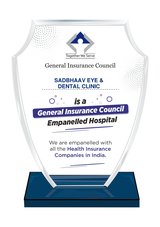
GIC empanelled: cashless treatment
Policyholders of member general and health insurers can ask for cashless eye treatment, subject to policy terms and pre-authorisation.
How cashless worksAll eye treatments (31)
Our Eye Treatments
- C3R Treatment for Keratoconus
- Cataract Surgery
- Cataract Surgery FAQ
- Computer Vision Syndrome
- Contact Lens Clinic
- Corneal Topography
- Diabetic Retinopathy Treatment
- Dry Eye Treatment
- Eye Injury & Emergency
- Eye Pressure Test
- Eyeglass Lens Guide
- Fundus Photography
- Glaucoma Treatment
- IOL Lens Types Guide
- LASIK Eye Surgery
- LASIK Treatment FAQ
- LASIK vs ICL
- Levels of Visual Impairment
- Neuro-Ophthalmology
- Oculoplasty
- Paediatric Eye Checkup
- Perimetry
- Phakic IOL (ICL)
- Pre-Operative Guide
- Procedure Preparation Checklist
- Pterygium Treatment
- Retina Treatment
- Squint Treatment
- Types of Eye Drops Explained
- Vision Acuity Explained
- YAG Laser Capsulotomy
Patient articles in English (17)
Patient Information Articles in English
- Artificial Lens in Cataract Surgery
- Atropine 0.01% in Myopia
- Cataract
- Cataract Surgery Packages (Gujarati)
- Computer Vision Syndrome
- Contact Lens Care Tips
- Does Your Child Have a Squint?
- Eye Donation Awareness FAQ
- Eye Exercises
- Eye Health, in Rhyme
- Floaters
- Glaucoma
- Interesting Eye Facts
- Intermittent Fasting and Eye Health
- OCT Angiography in Diabetic Retinopathy
- Tips for Television Watching
- Understanding Myopia
Patient articles in Gujarati and Hindi (19)
Patient Information Articles in Regional Language
- આંખની વાતો, કાવ્યમાં
- आँखों की बातें, कविता में
- આંખના ટીપાં કેવી રીતે મુકશો? How to put an Eye drop?
- આંજણી (STYE)
- ઓપ્થેલ્મોલોજિસ્ટ, ઓપ્ટોમેટ્રીસ્ટ અને ઓપ્ટીશિયન
- કન્જક્ટિવાઈટીસ (Conjunctivitis)
- ઝામર (Glaucoma)
- ટેલિવિઝન જોવા માટેની માર્ગદર્શિકા
- ડાયાબિટીસ અને આંખ (Diabetes & Eye)
- ત્રાંસી આંખો
- પાંપણોનો સોજો - બ્લેફરાઈટીસ (Blepharitis)
- ફ્લોટર્સ (Floaters)
- બેતાળા (Presbyopia)
- મોતિયાના ઓપરેશનના ઉપલબ્ધ પેકેજીસ
- મોતિયો (Cataract)
- રંગ દ્રષ્ટિ ઉણપ (Colour Vision Deficiency)
- વધતા ચશ્માના નંબર પર રોક લગાવતા Atropine 0.01% ટીપાં
- વેલ (Pterygium)
- સૂકી આંખો (Dry Eyes)