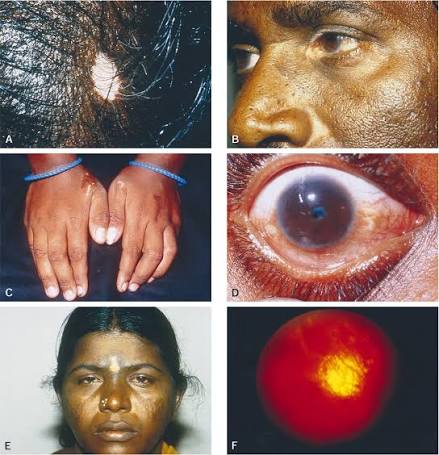
Vogt-Koyanagi-Harada Disease
Last updated: September 2026
Vogt-Koyanagi-Harada (VKH) disease is a rewarding diagnosis to get right early — the disease is autoimmune, not infectious, and early, aggressive, sustained treatment genuinely changes the long-term course from a single self-limited episode into a chronic, vision-threatening recurrent disease.
What's actually happening
VKH is a primary autoimmune stromal choroiditis targeting melanocytes — which explains its multisystem pattern, since melanocytes are found not just in the choroid but in the skin, hair, inner ear, and meninges. Strongly associated with HLA-DRB1*04.
Classic clinical picture
- Prodromal phase: flu-like illness, headache, and meningismus (neck stiffness) — often mistaken for viral meningitis before ocular symptoms appear
- Acute uveitic phase: bilateral granulomatous panuveitis, classically with diffuse choroiditis and exudative/serous retinal detachments; optic disc hyperemia and edema are common
- Auditory findings: tinnitus and sensorineural hearing loss, often early in the disease course
- Convalescent/chronic phase: depigmentation findings emerge weeks to months later — vitiligo (hands, face, lower back), poliosis (whitening of eyelashes/eyebrows/hair), and a characteristic "sunset glow fundus" from diffuse RPE depigmentation
A genuinely important current shift: simplified, imaging-based diagnostic criteria
The 2001 Revised Diagnostic Criteria remain widely referenced, but a significant critique has emerged: multiple studies found the revised criteria's complexity and reliance on multiple simultaneous findings actually failed to improve real-world disease management compared to simpler approaches. Current thinking has moved toward:
- Recognizing diffuse choroiditis on ICGA and/or enhanced depth imaging OCT (EDI-OCT) as essentially the sine qua non finding for acute initial-onset VKH — a single, reliable, imaging-based anchor rather than a checklist of multiple systemic criteria that aren't always present or easy to elicit early
- Explicit differentiation between acute initial-onset disease and chronic/chronic-recurrent disease, since these represent genuinely different treatment scenarios and prognoses
Treatment: why early and aggressive matters
- Early, high-dose, sufficiently sustained corticosteroid therapy during the acute phase is the single most important factor in preventing progression to chronic-recurrent disease — under-treatment (too low a dose, or tapering too quickly) is a well-recognized cause of relapse and chronicity
- Immunomodulatory therapy (mycophenolate mofetil, azathioprine, methotrexate) and biologics (adalimumab) are increasingly used earlier rather than only after steroid failure, particularly in patients showing early signs of a poor response
- Once chronic-recurrent disease is established, achieving remission becomes considerably harder — reinforcing why aggressive initial treatment is worth the upfront intensity
A rare but important current mimic to know
Immune checkpoint inhibitors (used in oncology, e.g., pembrolizumab) have been associated with a VKH-like syndrome as an immune-related adverse event — worth considering in any patient on checkpoint inhibitor therapy who develops new bilateral panuveitis, since this represents a distinct clinical scenario requiring coordination with the treating oncologist.
Key references: Precise, simplified diagnostic criteria and optimised management of initial-onset VKH disease: an updated review. Eye. 2021. | Comprehensive and updated review on the diagnosis and treatment of VKH disease. 2023. | Predictive factors and adalimumab efficacy in managing chronic recurrent VKH disease. 2024.
📘 Want the exam-ready deep dive? This topic, and much more is covered in Ophthalmology Explorer (A High-Yield Clinical Reference for Ophthalmology Residents, Fellows & Board Exams) — available on Kindle. See all my books.
Want to know more about treatment? Read about Corneal Topography at Sadbhaav or book a consultation with Dr. Dhaval Patel.