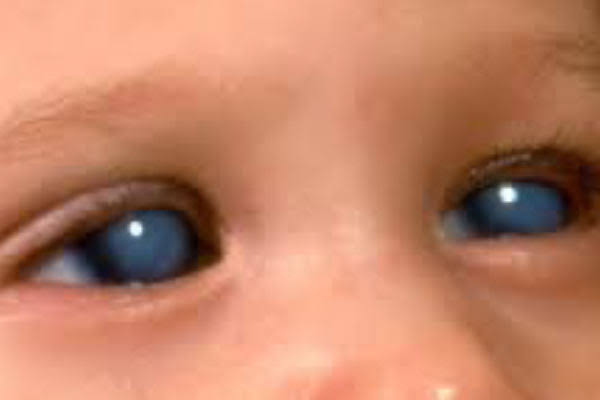
Primary Congenital Glaucoma
Last updated: September 2026
Primary congenital glaucoma (PCG) results from isolated developmental abnormality of the anterior chamber angle (goniodysgenesis), without other ocular or systemic anomalies — genetics have clarified much of the underlying mechanism, and surgical technique has genuinely advanced with the rise of minimally invasive approaches.
Classic triad — and why it's often missed
- Epiphora (tearing)
- Photophobia
- Blepharospasm
Buphthalmos (enlarged globe/cornea from elevated IOP in the pre-fusion sclera) and corneal edema with Haab's striae (breaks in Descemet's membrane) are supporting signs. Because this triad overlaps with simple congenital nasolacrimal duct obstruction — a far more common, benign condition — PCG can be missed early if IOP and corneal diameter aren't specifically checked in a tearing infant.
Current genetics
Four genetic loci are currently identified (GLC3A-D), with CYP1B1 as the best-characterized and most clinically relevant gene — mutations here are the leading known genetic cause of PCG. Other implicated genes include LTBP2 and TEK/Tie2, both involved in trabecular meshwork and Schlemm's canal development.
- CYP1B1 mutation severity correlates with goniodysgenesis severity on histology — underdeveloped collector channels and Schlemm's canal, abnormal ciliary muscle insertion, and trabecular endothelial cell death are the characteristic findings
- Some evidence suggests CYP1B1 genotype may have prognostic value for predicting surgical success — a genuinely emerging area, though not yet standard clinical practice
Surgical management: still the mainstay, now with more options
Medical therapy has a limited, mainly adjunctive/temporizing role in PCG — surgery targeting the abnormal angle is the definitive treatment:
- Goniotomy — an internal incision through the abnormal trabecular meshwork, usually the first-line choice when the cornea is clear enough for a good view
- Trabeculotomy ab externo — an external approach, useful when corneal haze limits the gonioscopic view needed for goniotomy
- Gonioscopy-assisted transluminal trabeculotomy (GATT) — a newer minimally invasive approach (a form of MIGS adapted to pediatric glaucoma) that has shown efficacy comparable to conventional trabeculotomy ab externo in recent series, using Schlemm's canal microcatheterization and viscodilation via systems such as the OMNI surgical system
- Glaucoma drainage implants and cyclodiode photocoagulation — reserved for eyes that fail angle-based surgery, or where angle surgery isn't technically feasible
- Many children require more than one procedure — this should be discussed with families from the outset rather than presented as a single definitive fix
Why early diagnosis genuinely changes outcomes
Unlike adult glaucoma, where visual field loss is the main concern, PCG left uncontrolled in infancy risks corneal decompensation, axial myopia from globe enlargement, and amblyopia from both image degradation and the myopic refractive shift — meaning the visual stakes of delayed diagnosis extend well beyond the optic nerve itself.
Key references: Update in Genetics and Surgical Management of Primary Congenital Glaucoma. Turk J Ophthalmol. 2020. | Primary Congenital and Childhood Glaucoma: A Complex Clinical Picture. Diagnostics. 2025. | Gonioscopy-Assisted Transluminal Trabeculotomy in PCG: case report. 2025.
📘 Want the exam-ready deep dive? This topic, and much more is covered in Ophthalmology Explorer (A High-Yield Clinical Reference for Ophthalmology Residents, Fellows & Board Exams) — available on Kindle. See all my books.
Want to know more about treatment? Read about Corneal Topography at Sadbhaav or book a consultation with Dr. Dhaval Patel.