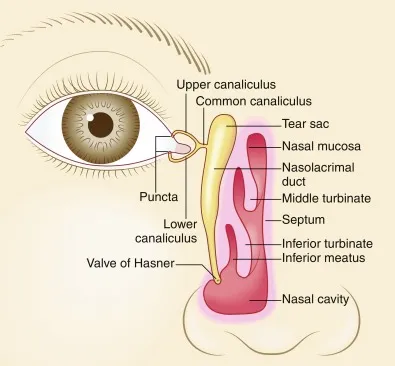
Congenital NLD Obstruction: When to Wait, When to Act
Last updated: September 2026
Congenital nasolacrimal duct obstruction (CNLDO) is common — affecting up to 20% of infants — and the good news for anxious parents is that the large majority resolve without any procedure at all. The real clinical skill is knowing when to keep waiting and when watchful waiting has gone on long enough.
Mechanism
Most commonly caused by a persistent membranous obstruction at the distal nasolacrimal duct, at the valve of Hasner — essentially a failure of complete canalization that would normally occur before birth.
First: always exclude the mimics
A thorough exam is essential before assuming "simple" CNLDO — congenital glaucoma can also present with tearing, and must be actively excluded (check corneal diameter and clarity, consider IOP if any doubt) — see our Primary Congenital Glaucoma page. Keratoconjunctivitis and eyelid malposition are other differentials worth considering.
Step 1: Conservative management (first 6-12 months)
- Lacrimal sac massage (Crigler maneuver) — firm downward pressure over the lacrimal sac, which can help rupture the membranous obstruction hydrostatically; recommended as first-line even in children older than 6 months by some authors
- Lid hygiene
- Topical antibiotics only for short courses during active bacterial superinfection — not for routine ongoing use
Spontaneous resolution rates are genuinely high, particularly in the first year: roughly 80-90% resolve in the first 3 months of life, 68-75% in the second trimester, and 36-57% in the third trimester of the first year — meaning resolution is most likely early and progressively less likely to happen spontaneously as the child gets older, without being impossible.
Step 2: Probing — the timing controversy
This is a genuinely unresolved area, and reasonable practices vary by center:
- PEDIG's landmark trial compared immediate office-based probing against 6 months of conservative management followed by deferred facility-based probing if still unresolved — nearly two-thirds of the conservative-management group resolved without any procedure, but immediate probing was more cost-effective overall
- Success rates are comparable between early and late primary probing (roughly 75-80% in both groups) if performed before about 16 months of age — supporting a reasonable "wait, then act" approach rather than rushing to probe every case
- Most guidelines now support conservative management as first-line for children under 6-12 months, given the high spontaneous resolution rate in this window, reserving probing for persistent obstruction beyond that point
- General anesthesia is typically required for probing after around 12 months of age, which itself factors into timing decisions and resource availability
Step 3: When probing fails
- Repeat probing — success rates drop substantially with each attempt and with increasing age: one series found 52% success for repeat probing at 6-18 months, falling to just 18% at 18-24 months — a sharp, clinically important decline that should inform counseling about further repeat attempts versus escalating to a different approach
- Silicone tube intubation — recommended for complex, recurrent, or age-advanced failed cases, with substantially improved success rates over repeat simple probing alone
- Balloon catheter dilation — an alternative or adjunct to intubation in select cases
- Endoscopic techniques (transcanalicular dacryoendoscopy, endonasal endoscopy) — increasingly used for refractory or anatomically complex obstructions, allowing direct visualization rather than the traditionally "blind" probing technique
- Dacryocystorhinostomy (DCR) — reserved for cases refractory to the above, or where the obstruction is more proximal/complex than simple distal duct membrane
Key references: Congenital Nasolacrimal Duct Obstruction: A Review. Diseases. 2018. | Navigating CNLDO: A Practical Guide to Stepwise Management. 2025. | Congenital nasolacrimal duct obstruction: clinical guideline. Jpn J Ophthalmol. 2024.
📘 Want the exam-ready deep dive? This topic, and much more is covered in Ophthalmology Explorer (A High-Yield Clinical Reference for Ophthalmology Residents, Fellows & Board Exams) — available on Kindle. See all my books.
Want to know more about treatment? Read about Corneal Topography at Sadbhaav or book a consultation with Dr. Dhaval Patel.